Picture a store that posts a ROAS of 4.0 for three months and keeps raising the budget. Then the accountant points out that the products driving most of those sales carry the thinnest margins in the catalog, and the campaign has been quietly paying to sell them. ROAS was never wrong. It just never knew what anything cost.
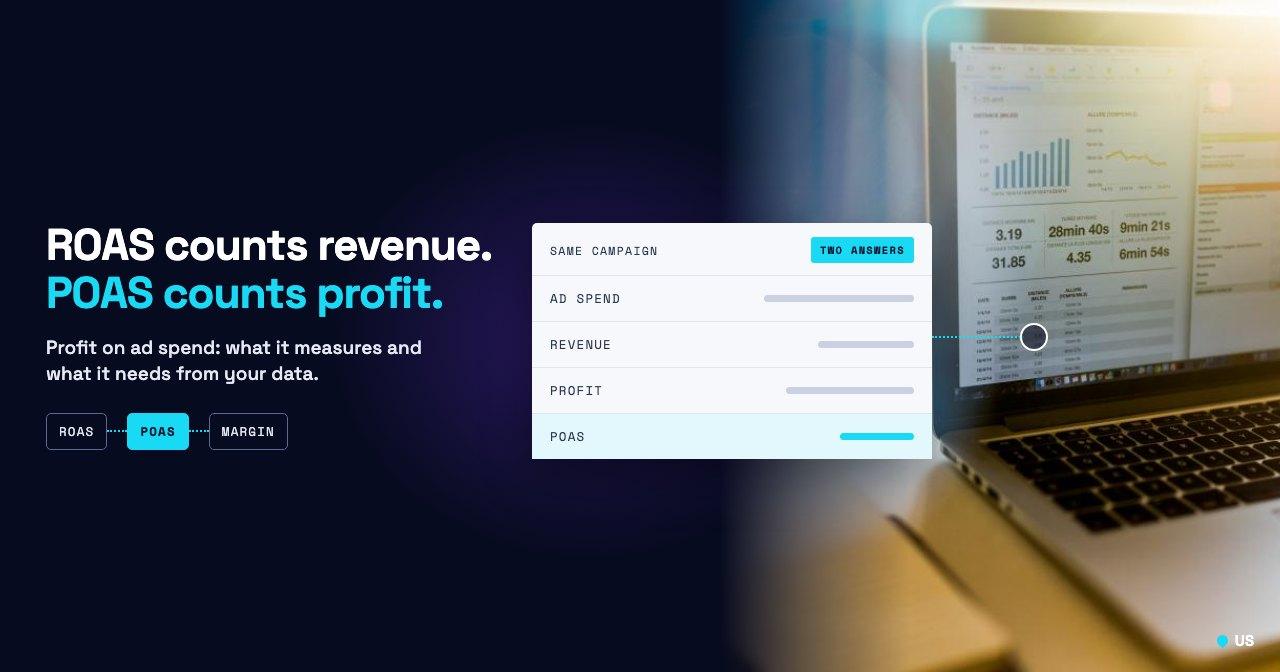
POAS (profit on ad spend) is the profit your ad-driven orders earn, before the ad cost, divided by what you spent on the ads. A POAS of 1.0 is break-even. It fixes the main blind spot of ROAS by building margin into the number. The formula is simple; the work is getting an accurate, current profit figure for every product into your ad platform at the moment of purchase. This piece covers the calculation, how to feed profit into Google Ads, the failure that wrecks most attempts, and when it is not worth doing.
This is written for the founder or marketing lead of a US ecommerce brand spending real money on Google, who has noticed that ROAS and profit do not move together. It is a decision guide, not a setup tutorial.
The POAS formula
POAS = profit from ad-driven orders, before ad cost / ad spend.
If $10,000 of ad spend drives orders that leave $24,000 after product cost, shipping, payment fees and an allowance for returns, POAS is 2.4. For every dollar spent, $2.40 of margin came back to pay for that dollar and everything else the business carries.
On this definition, 1.0 is break-even and anything under 1.0 loses money on the first order. Some people define POAS on profit after ad cost instead, which makes break-even zero. That is the same information with a different origin. The before-ads version is the better one to work with, because it is the number you can send to an ad platform as a conversion value, and because it sits on the same scale as ROAS: you read 2.4 the way you read a ROAS of 2.4, except the dollars are margin.
Why two products with the same ROAS can have opposite results
Here is the case that sells the idea. Two products, each at $100, each costing $25 in ad spend per order.
| Product A | Product B | |
|---|---|---|
| Price | $100 | $100 |
| Profit before ads (after product cost, shipping, fees, returns allowance) | $60 | $20 |
| Ad spend per order | $25 | $25 |
| ROAS | 4.0 | 4.0 |
| POAS | 2.4 | 0.8 |
| Result per order after ads | +$35 | -$5 |
Both products look identical in a ROAS column. Product B loses $5 every time it sells through an ad. Blend them into one campaign with a ROAS target of 4.0 and the platform has no reason to prefer A over B. If B is cheaper to click on, it may well get more of the budget.
The break-even ROAS for each is 1 divided by its margin: about 1.67 for A and 5.0 for B. A single ROAS target either starves A or overfeeds B. POAS removes the argument because the margin is already inside the number. For the margin arithmetic itself, build the contribution margin first, and ROAS versus ROI covers why revenue ratios and profit ratios drift apart.
Which costs go into the profit figure
The profit you send should be the profit the order earned before advertising. In practice that means price minus product cost, minus packing, minus shipping you pay, minus payment processing, minus an allowance for returns. That is the same before-ads figure as contribution margin, so build it once and use it for both. Sales tax stays out because it was never yours.
Shopify's own profit reports are a useful reality check on how much this takes. Profit is reported only for products and variants that had a cost recorded at the time they sold, and Shopify's documentation says the cost per item field contains static data, so reports reflect the figure at one point in time. Its gross profit is net sales minus that cost, which leaves out packing, fees and returns. A POAS built on gross profit alone is a looser version than one that subtracts fulfillment and fees. Decide which you are using and write it down, because two people quoting different versions in the same meeting will disagree about the same account.
How profit gets into Google Ads
Google Ads bids on whatever conversion value you give it. Its documentation says the target ROAS strategy sets bids to maximize conversion value while aiming for a return on ad spend, and that the strategy can aim at "sales revenue or profit margins". So the mechanism is to send profit instead of revenue as the purchase value.
There are two parts to that. The first is a dynamic value in the conversion tag: Google describes dynamic values as a more accurate representation of each transaction's value than a single static value. The second is computing the profit before it is sent. Your tag needs line-item data joined to a cost per item, which means the product cost has to live somewhere your site can read at checkout, or be applied server-side afterwards.
One distinction is easy to miss. Google's conversions with cart data feature combines cart data with the cost of goods sold in Merchant Center and reports gross profit. Google describes that as reporting and insights, such as bidding more on products that lead to higher-value purchases. It does not describe it as an input to bidding. It is a good place to look at profit by product; it is not the same as sending profit as the conversion value, and it should not be assumed to steer a bid strategy.
Setting the target
When the conversion value is profit before ads, a target of 100% is break-even. A target of 150% asks for $1.50 of profit per dollar spent, which leaves $0.50 after ads. Your real target comes from what the business needs the first order to contribute after advertising, which is a finance decision before it is a bidding one.
Resist copying your old ROAS target across. Google advises uploading values for three weeks or one to two conversion cycles, whichever is longer, before switching to value-based bidding, and warns against backfilling historical value data. It also suggests using your own last 30 days of performance as the benchmark for a target. After a switch to profit, that history is on a different scale, so the first weeks need a deliberately loose target and close watching.
The failure to plan for: stale or partial cost data
This is the one that quietly costs people money. Profit is sent as the value, and for part of the catalog the profit figure is wrong. Costs were entered a year ago and supplier prices have moved. A new line launched with no cost entered at all. A bundle inherits the cost of one of its parts.
Automated bidding does not know any of this. It sees a value and chases it. If a product with no cost entered is sent at full revenue, it looks like the most profitable thing you sell, and the campaign leans into it. If it is sent at zero, the campaign avoids it, however good the real margin. Either way the bidder is optimizing toward whichever products have the most flattering or the most missing data, which can be the opposite of the best margin.
There is no clean published study of how often this happens that this article can cite, so treat the pattern as a risk and not a statistic. It follows directly from how value bidding works: the system optimizes the numbers it is given. Before going live, audit every product for a cost, decide what happens to a product without one (the safer default is to hold it out of the value-bidding campaign instead of guessing), and set a recurring check on when each cost was last updated.
Data and volume requirements
Value bidding needs enough conversions to learn. Google's guidance for target ROAS is at least 15 conversions in the last 30 days at the conversion tracking level, with conversion delays under seven days recommended, and Google also recommends measuring at least two unique values. That is a floor, not a comfortable level. The more your profit values vary across products, the more orders it takes before the system separates a genuinely good product from a lucky week.
Tracking quality comes first. If the purchase tag double-fires or sends the wrong amount, profit bidding multiplies the error. Reconcile platform-reported value to your store's own numbers before you change what the value means. This is the first stage of our analytics work for exactly that reason, and the same logic applies to Performance Max, which will chase any value you send.
What you give up
Switching the value to profit changes what every column in the account means. Conversion value per cost now reads as profit return, so comparing it with last quarter's revenue ROAS is meaningless, and comparing it with a platform you have not converted, such as Meta, mixes two scales. Reports that other people read need a label.
You also lose some visibility. A revenue ROAS lets a marketer say "we sold $80,000 from this campaign" in one glance. With profit as the value, that number is gone from the platform and has to come from the store. For a small team that is a real cost.
When POAS is not worth the plumbing
The honest answer is "often". Skip it, or delay it, in these cases:
- A tiny catalog with uniform margins. If every product earns roughly the same percentage, revenue and profit rank products the same way. ROAS with the right break-even target does the job. A good ROAS target is just 1 divided by your margin.
- Too few conversions. If the account sits below the volume value bidding wants, a profit value just makes a thin signal noisier.
- Costs you cannot keep current. If cost data changes weekly and nobody owns it, stale data is worse than a flat value.
- Repeat purchase carries the economics. First-order profit undervalues acquisition when the real return arrives over a year.
If you are weighing which of these fits, how to calculate ROAS and your break-even are the place to start, because that number is POAS's cheaper cousin.
A short checklist before you switch
- Decide the profit definition and write it down.
- Confirm every product and variant has a current cost.
- Reconcile tracked purchase value to the store before changing it.
- Choose what happens to products without a cost.
- Report values for three weeks or one to two conversion cycles before switching.
- Start with a loose target and compare real profit against what the platform reports.
If you would like someone to check your cost data and tracking before profit goes anywhere near a bid strategy, request a free audit.
Sources.
- Conversion values best practices — Google Ads Help (accessed November 2026)
- About Smart Bidding using value-based bidding for Search and Shopping — Google Ads Help (accessed November 2026)
- About conversions with cart data — Google Ads Help (accessed November 2026)
- Conversion values — Google Ads Help (accessed November 2026)
- Profit reports — Shopify Help Center (accessed November 2026)