Search "omnichannel retail marketing" and Google hands back a stack of software vendors. Salesforce. Emarsys. MoEngage. Oracle. McKinsey. The message, in aggregate, is that omnichannel is a customer-experience problem to be solved with CRM and CDP software.
For a CMO running 30 to 300 physical shops in the UK, that is not wrong, exactly, but it is also not the part of the job that keeps you up at night. The part that keeps you up at night is whether the Google Ads budget that paid for the phone search that led someone into the Glasgow branch last Tuesday is actually getting credit for that sale in any system you can look at.
This article is the collapse of the omnichannel jargon into the concrete practice: what omnichannel retail marketing actually means for a UK multi-store retailer, where it fails, and what it looks like when it works.
For a UK multi-store retailer with physical shops, omnichannel retail marketing is not a CRM software decision. It is a paid-media attribution problem. The majority of the gap between what is being spent on Google Ads and what the business actually earns sits in the measurement layer: Store Visit Conversions not turned on, Offline Conversion Tracking not wired to the POS, and smart bidding optimising against online-only conversions when in-store revenue is four to five times larger. Fix those three failures, in that order, using Google-native tools. Do that before touching any CDP or personalisation platform. The customer-experience software is a Layer 4 upgrade. The paid-media measurement fix is the foundation. Most UK retailers are skipping the foundation and buying the upgrade.
One customer, two journeys. That is the shape of modern UK retail buying. Solving for that shape in paid media, measurement, and operational practice is the job.
Omnichannel retail marketing vs multichannel: the practical distinction
Omnichannel and multichannel are not interchangeable terms, and the gap between them is where most UK retailers' paid-media budget silently leaks. Multichannel means a brand has multiple channels that each work on their own. Omnichannel means those channels are integrated, and a customer can move between them without losing their place.
The practical distinction for a UK retailer with physical shops is sharper. In a multichannel world, the website, the app, the stores, the Google Ads account, and the loyalty programme all report their own performance on their own terms, and nobody inside the business can tell you, in one view, whether paid media is making the shops more productive.
In an omnichannel world, the measurement layer is unified. A paid search click in Liverpool ends in a shop visit in Liverpool, the transaction is imported back into Google Ads with a revenue value, the attribution model sees the full path, and the CMO's monthly report shows blended online plus in-store revenue per pound of paid media spent. The software stack can be any reasonable combination; the measurement integrity is the test.
Most UK retailers sit somewhere between the two. They have the multichannel presence. They are missing the measurement glue.
Why the online / offline split is the wrong mental model for UK retailers
The online/offline split is the wrong frame because UK retail still happens predominantly in physical shops. Paid media is the upstream driver of both journeys. Bringing online and offline performance together is the whole job. The "online versus offline" dichotomy the SaaS vendors use is a hangover from a time when those were two separate businesses with two separate P&Ls.
For a UK multi-store retailer in 2026, there is one business and one P&L. Online Services of Retail Sales data from the ONS continues to show most non-food retail revenue happening in physical shops, even after the e-commerce surge earlier this decade (source: https://www.ons.gov.uk/businessindustryandtrade/retailindustry/bulletins/retailsales/latest). The site exists to get people to the shop as much as it exists to sell directly.
Research online, purchase offline. ROPO. For furniture, cars, appliances, and most higher-consideration retail categories, the final purchase is a physical-location event that was seeded online hours or days earlier. The paid media that seeded that journey is either measured properly and credited, or it is cut in the next quarterly review because the online conversion number looks small.
So the real question behind "what is omnichannel retail marketing" for a UK CMO is not how to make the customer experience feel joined up. It is how to measure the experience well enough that the Google Ads budget survives the next board meeting.
The data problem: why omnichannel fails without unified measurement
Omnichannel strategy without unified measurement is marketing theatre. The three specific data failures below are what make it theatre, and they are all fixable without a platform purchase. Without proper integration, nobody knows which products customers bought in-store after coming in from a paid media click. That is the sentence the Salesforce and MoEngage articles talk around without quite saying.
Three specific data failures turn an omnichannel strategy into marketing theatre.
Store visits are not imported into Google Ads. Google's modelled Store Visit Conversions (which measure how many ad clicks led to a physical shop visit, using anonymised location signals) are available to most UK retailers with a Google Business Profile and sufficient traffic, but they have to be turned on and flagged as a conversion action. A surprising number of UK retail accounts leave this setting off.
In-store transactions are not imported either. Offline Conversion Tracking (which sends real POS or CRM transaction data back into Google Ads by matching Click IDs to in-store transactions) sends real transaction data back into Google Ads as a conversion with a cash value. Without this import, smart bidding optimises toward whatever online conversion exists, which is almost always a smaller number than the in-store equivalent.
The conversion action priority is wrong. When store visits and in-store transactions are imported but the primary conversion action stays set to online sales, the algorithm still starves physical-shop outcomes. Fixing this is a setting, not a project.
Omnichannel is what you get when all three failures are fixed. The CRM and CDP pieces the SaaS vendors focus on sit on top of this foundation, not instead of it.
Building an omnichannel stack for a UK multi-store retailer
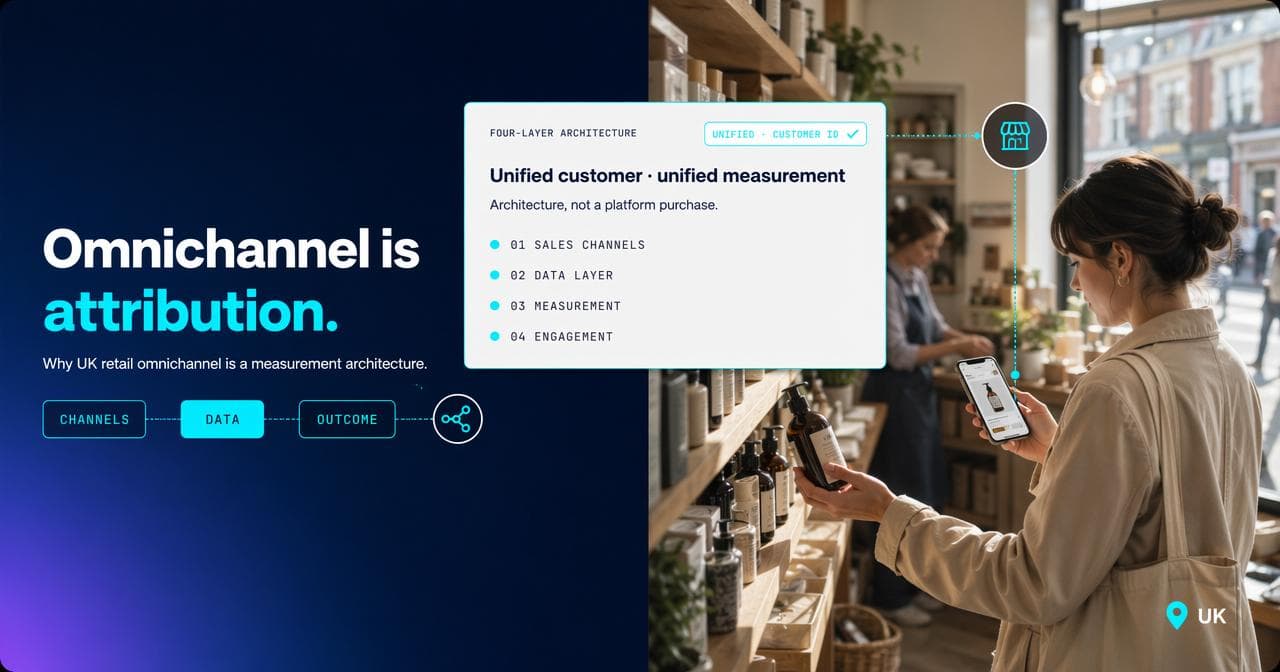
Four layers, in order, are what a working omnichannel stack for a UK multi-store retailer looks like. The sequence matters as much as the components. The SaaS vendors sell Layer 4; most UK retailers need to fix Layers 1 to 3 first.
Layer 1: ad platforms. Google Ads is the primary demand-capture layer. Search, Shopping, Performance Max (Google's automated campaign type that combines Search, Shopping, Display, YouTube, and Discovery signals into one campaign with unified creative and bidding), Demand Gen, and Local Inventory Ads (Google's format for surfacing per-shop stock availability in Shopping results for nearby searches) all sit here. Meta Ads is the secondary layer for upper-funnel acquisition, deferred until the offline-conversion plumbing is proven. BYLT's own coverage of the UK Google Ads retail advertising guide explains the five-format setup in detail.
Layer 2: Google data infrastructure. Merchant Centre (Google's product catalogue and feed management platform that powers Shopping and Performance Max inventory) handles the product feed, Local Product Inventory Feed (per-shop stock and price), and connects to Google Business Profile (shop records). These three feed Shopping, PMax, and Local Inventory Ads. Feed health is upstream of every ad output.
Layer 3: measurement. Store Visit Conversions via Google (modelled). Offline Conversion Tracking via POS or CRM integration (deterministic). Full detail in the offline conversion tracking for UK retailers guide. Data-driven attribution turned on inside Google Ads. GA4 for cross-channel visibility. How the data layer gets operationalised is covered in the store visit data for paid media guide.
Layer 4: CRM / CDP / engagement. This is where Salesforce, Emarsys, MoEngage, and similar tools live. They handle customer-data unification, email, SMS, personalisation, and loyalty. They are genuinely useful. They are also not the retail-revenue lever most UK multi-store retailers most urgently need to pull. Layer 4 without layers 1-3 is an expensive CRM project that does not move shop revenue.
The order matters because ad platforms are where the revenue actually comes from, the Google data infrastructure is the fuel, measurement is the feedback loop, and CRM/CDP is the customer-retention layer that compounds once the acquisition engine is working.
Omnichannel KPIs that connect digital spend to physical sales
KPIs are the place the omnichannel strategy either holds together or falls apart. The metrics below are not consumer-experience scores; they are the numbers that connect what was spent on paid media to what was earned in the shops.
The KPI list a UK retail CMO should be able to look at in one monthly view:
Blended ROAS (online plus in-store). Return on paid media spend measured against online plus in-store revenue attributable to the campaign. This is the headline metric the business runs on.
Cost per store visit. What Google Ads spent, divided by Store Visit Conversions recorded. Gives a per-visit productivity measure on the Local campaigns.
In-store revenue per online click. Harder to compute without Offline Conversion Tracking wired in; once wired, it is the conversion between "a click in the account" and "pounds in the till."
Total business impact vs online-only conversions. The ratio between the blended number and the online-only number tells you how much of the picture your old reporting was missing. On a functioning retail account with ROPO behaviour, that ratio is often between two and five times.
Share of paid media on local versus national intent. Not a revenue KPI directly, but the structural indicator that tells you whether the campaign split is right.
Consumer experience metrics the CRM/CDP vendors emphasise (NPS, email CTR, personalisation coverage) have a role, but they are Layer-4 metrics. They indicate customer engagement. They do not, on their own, tell the CMO whether paid media is working.
What omnichannel measurement looks like in practice
The pattern is straightforward when the software-sales language is removed: a UK multi-store retailer running on last-click online attribution today can rebuild the measurement layer in three to four months, without a platform change, using Google-native tools. Here is what that sequence actually looks like.
The starting point: Google Ads account with 30 to 50 search and shopping campaigns, a Merchant Centre feed that has not been audited this year, a Business Profile for each shop, no Store Visit Conversions turned on, no Offline Conversion Tracking, last-click attribution, and a CMO reporting online ROAS to the board every month.
Month one: feed and profile audit. All 30-300 shop records checked, corrected, and unified. Merchant Centre errors cleared. Local Product Inventory Feed set up for retailers running local stock.
Month two: measurement turn-on. Store Visit Conversions eligibility confirmed and enabled. Offline Conversion Tracking pipeline built, typically with a monthly upload of matched POS data by Click ID. Data-driven attribution switched on in Google Ads.
Month three: campaign re-split along the local-versus-national axis. Performance Max store goals configured correctly. Local Inventory Ads turned on. Smart bidding targets updated to reflect total business value, not online-only conversions.
Month four onward: the reporting view switches. Monthly board report shows blended ROAS, cost per store visit, and the ratio of in-store to online revenue attributable to paid media. Budget reallocation happens against these numbers, not the old online-only numbers.
This is not a six-month software implementation. It is a three-to-four-month sequencing exercise with clear checkpoints. The software layer comes after, not before.
Common omnichannel myths for UK retail brands
The five myths below come directly from the SaaS-vendor framing that dominates the omnichannel SERP. Each one is understandable in context and wrong in practice for a UK multi-store retailer who needs to defend a paid-media budget.
"The vendors are selling the Layer 4 upgrade as if it is the whole building. For a UK retailer with 30 to 300 shops, Layer 4 on top of broken measurement is a very expensive way to remain confused about whether your Google Ads spend is working." Teo Yordanov, BYLT Media
Myth 1: "We need a CDP before we can do omnichannel." No. A CDP helps at Layer 4. The paid-media-plus-measurement layers can be fixed with Google-native tools today. The CDP investment is an upgrade, not a prerequisite.
Myth 2: "Omnichannel is mainly about customer experience." Partly. The CX piece matters, and the SaaS vendors are right about that. For a UK multi-store retailer, the measurement piece matters more in the first year, because without it, the paid-media budget cannot defend itself.
Myth 3: "Retail media networks (Tesco Media, Boots Retail Media, Nectar360) make omnichannel optional." No. Retail media is a paid channel inside someone else's storefront. It is not the same problem as measuring your own shops' revenue attributable to your own paid media. The two stacks are parallel, not substitutes.
Myth 4: "Online and offline are still separate budgets." They might be in the current ledger, but the customer is one customer. A multi-store retailer running Google Ads on an online-only budget line is underfunding the paid media that drives its shops.
Myth 5: "Last-click attribution is fine because it is conservative." Last-click attribution in a retail context systematically undervalues upper-funnel and local-intent activity. Conservative is a polite word for "wrong in a predictable direction."
Sources.
- Retail sales, Great Britain (latest bulletin) — Office for National Statistics (accessed April 2026)