Most definitions of retail digital marketing come from a US software vendor or a generalist agency blog. None map to how a CMO at a UK multi-store retailer actually spends a media budget.
Here is the working definition I opened with on the Brighton SEO stage this month.
Retail digital marketing is bringing online and offline performance together. It is the discipline of running paid media, measurement, and local signals so an online search or ad impression ends in a purchase, whether that purchase happens on the site or in one of your shops.
That separates it from ecommerce digital marketing, where every conversion lives on the website. It also tells you where measurement has to go: not just online sales, but store visits and in-store revenue tied back to the campaign that caused them.
For a UK business with 30 to 300 shops, that is the whole job.
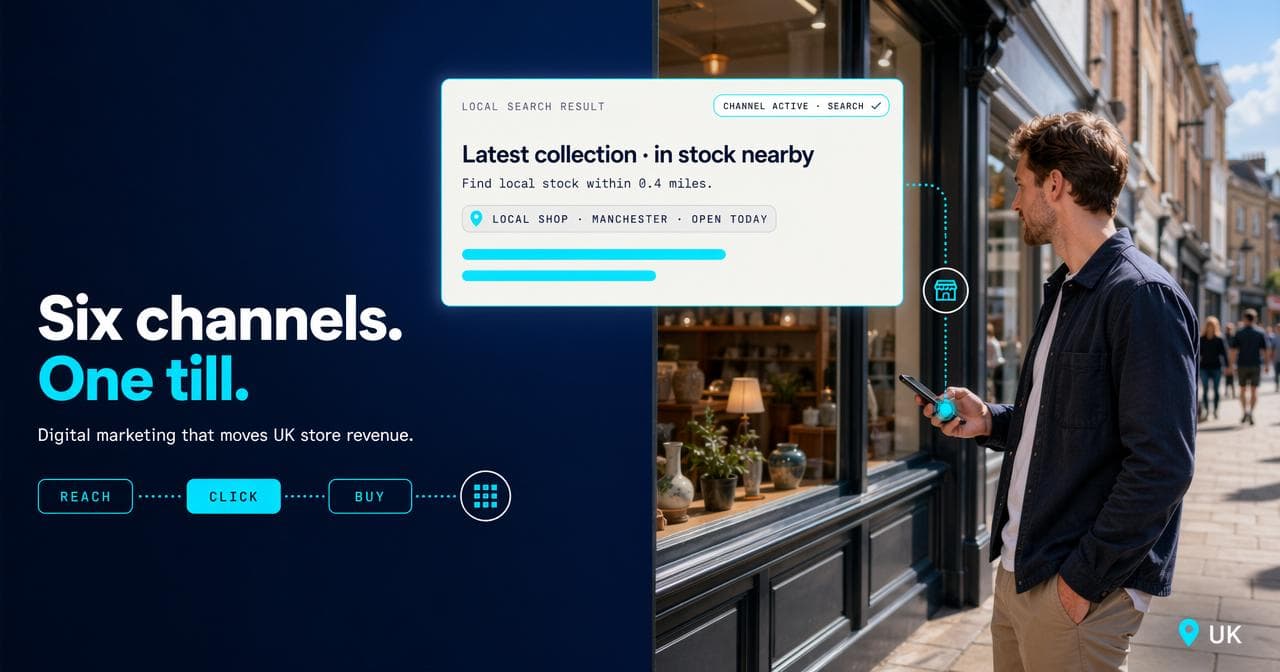
Retail digital marketing for UK multi-store retailers is not a generic checklist of SEO, email, and social. It is a paid-media-led architecture built around six channels and one job: closing the loop between an online search and an in-store purchase. The six channels are Google Ads (Search, Shopping, and Performance Max), Google Business Profile with Local Inventory Ads, Meta Ads, SEO and content, organic social, and email or CRM. Google Ads and Google O2O attribution form the measurable spine. The other channels support. Last-click reporting misses most of the value. The CMOs getting this right are measuring blended online plus in-store revenue and running local and national budget pots separately.
One customer, two journeys
The shape of modern UK retail buying is simple to describe and awkward to measure: one customer completes research online but converts in a physical shop, and last-click reporting credits neither channel properly.
The shape of modern UK retail buying is simple to describe and awkward to measure. One customer, two journeys.
Most people do their research online first, but the final purchase often happens in-store. This is the ROPO effect, research online, purchase offline. For a multi-store retailer selling furniture, carpets, supplements, bikes, or appliances, the in-store purchase is the main event and digital marketing is what gets the customer there.
The job is not to drive the last click. It is to drive the next visit.
Why this is not the same as ecommerce digital marketing
Ecommerce digital marketing and retail digital marketing look similar on paper but solve completely different problems, and treating them the same is where most UK retailers bleed budget.
Ecommerce digital marketing is a closed loop. The site is the shop. Attribution is clean because the whole journey lives inside cookies, pixels, and checkout events.
Retail digital marketing breaks that loop on purpose. Customers use the site to compare, check stock, read reviews, pick which shop to go to, and then they travel. The ad that pulled them in never sees the sale. If your measurement only looks at online conversions, you will cut paid search on local inventory terms and watch your stores go quiet a fortnight later.
ONS retail sales data still shows the majority of non-food retail sales happening in physical stores, even after the ecommerce surge of the early 2020s (source: https://www.ons.gov.uk/businessindustryandtrade/retailindustry/bulletins/retailsales/latest).
The six channels of retail digital marketing, ranked by measurable impact
For UK multi-store retailers, six channels drive measurable in-store and online revenue. The order matters because the first two do most of the commercial work.
There are more than six channels you could spend money on. These are the six that matter when the goal is to drive measurable in-store and online revenue for a UK multi-store retailer.
1. Google Ads: Search, Shopping, and Performance Max. Performance Max (Google's automated campaign type that serves across Search, Shopping, Display, YouTube, and Maps from a single asset group) is the demand-capture engine. When someone types a product, a brand plus location, or a near-me query, Google Ads is where the intent lives. Shopping and Performance Max both pull from the Merchant Centre feed (Google's product data platform where retailers upload inventory, pricing, and availability), which is why feed hygiene sits upstream of everything else.
2. Google Business Profile and local inventory ads. Local Inventory Ads (Google's ad format that shows nearby shoppers which local stores have a product in stock, at what price, and at what distance) sit between your Merchant Centre feed and your Google Business Profile. They show a shopper searching from their phone which of your local shops has the item in stock, at what price, and how far away it is. Google's own data on retailers running Local Inventory Ads alongside Shopping ads shows a 21% increase in shop visits and a 9% increase in online conversions (source: https://support.google.com/merchants/answer/14615117). That is the uplift most UK retailers are leaving on the table.
3. Meta Ads. Paid social for retail is largely Meta. For multi-store retailers it is a demand-generation channel first, retargeting second. It works hardest when the catalogue is plumbed into a product feed and offline conversions flow back through CAPI.
4. SEO and content. Organic search is a long-horizon channel carried by category pages, store locator pages, and branded content. Not the spine, but the spine does not work without it. An empty store locator page kills paid performance on local queries.
5. Organic social. Useful for brand, community, and service. Rarely moves revenue inside a quarter.
6. Email and CRM. For retailers with a mature loyalty programme, email keeps customers in the rotation between purchases. Not in BYLT's service remit, but it removes pressure from paid acquisition.
Paid search and Shopping convert existing demand. Meta and Local Inventory Ads redirect demand toward stores. Everything else supports.
Channels at a glance
| Channel | Primary role | Revenue impact | UK multi-store fit |
|---|---|---|---|
| Google Ads: Search, Shopping, Performance Max | Demand capture | High: direct ROAS measurable | Core. Pulls on branded, category, near-me intent. |
| Google Business Profile + Local Inventory Ads | Demand redirection to store | High: uplift on shop visits and online CVR | Core. Requires tidy Merchant Centre feed. |
| Meta Ads | Demand generation + retargeting | Medium: brand and top-funnel, improves with CAPI | Secondary. Strongest on prospecting and catalogue retargeting. |
| SEO and content | Organic visibility | Low (short-term), Medium (long-term) | Supporting. Category and locator pages carry the organic load. |
| Organic social | Brand and community | Low | Supporting. Rarely moves in-quarter revenue. |
| Email and CRM | Retention and repeat purchase | Medium (for mature loyalty programmes) | Supporting. Outside BYLT's remit but reduces paid acquisition pressure. |
Building the mix for a UK multi-store retailer
The right budget allocation splits local from national from the start. Running a single national campaign and hoping geography sorts itself out is where most plans lose in-store revenue.
Budget allocation is where most plans fall apart. The mistake is running one national campaign and letting geography sort itself out.
The split that works is local plus national. Local campaigns speak to "visit today" or "click and collect" intent, with postcode targeting, store-specific creative, and bids that flex by shop performance. National campaigns focus on delivery, online promotions, and brand-level demand generation. A 50-shop retailer typically runs 50 local budget pots fed off a central strategy, with the national campaign on top.
Demand capture versus demand creation is the other axis. Search, Shopping, and branded paid social capture existing demand. Performance Max and Meta prospecting create demand you did not have yesterday. Most CMOs I speak to are either 90% one or 90% the other. The healthy ratio usually lands closer to 60/40 capture to creation, flexing by season. For the broader framing, see our retail marketing strategy.
Attribution: why last click fails physical retailers
Last-click attribution assigns all conversion credit to the final touchpoint before purchase. For physical retail, that is almost always the wrong touchpoint.
Last-click attribution works when every sale is on the website. For retail it is actively misleading.
The fix is a stack. Offline conversion tracking (the process of importing in-store sales data from your POS or CRM back into Google Ads matched to the original click ID) closes the loop between an online ad click and an in-store sale. Store Visit Conversions (Google's modelled signal for how many store visits a campaign drives, available inside Google Ads) gives directional data on ads that drove visits. Merchant Centre plus Local Inventory Ads layer stock availability on top.
Stitch those three together and the picture changes. A campaign that looked flat on online ROAS often turns out to be the top driver of blended revenue once store visits and in-store sales are counted.
This is also why I push back on the phrase "footfall tracking". Footfall as a standalone KPI is a vanity metric. The number on its own does not change bids. Feeding it into Google Ads as a conversion signal does.
Who is doing it well
The UK retailers running this properly share one thing: they measure the blended picture, not just online conversions.
The UK retailers running this properly are usually less visible than the trend-piece favourites. Automotive retail groups, furniture retailers, carpet retailers, and supplement retailers with physical shops across 40 to 200 locations. The pattern is consistent: a tidy Merchant Centre feed, Local Inventory Ads on every SKU with in-store stock, Performance Max with store goals, offline conversions flowing back into Google Ads, Meta CAPI in place for prospecting. Most work with a specialist retail paid media partner that measures store visits as a primary campaign signal. For a worked example, see our retail marketing case study.
What these retailers share is not scale or sector. It is a willingness to treat the blended picture, online plus in-store, as the single scoreboard.
For the strategic layer, read our UK multi-store retailer paid media playbook.
Sources.
- Retail sales, Great Britain (latest bulletin) — Office for National Statistics (accessed April 2026)
- About Local Inventory Ads — Google Merchant Center Help (accessed April 2026)