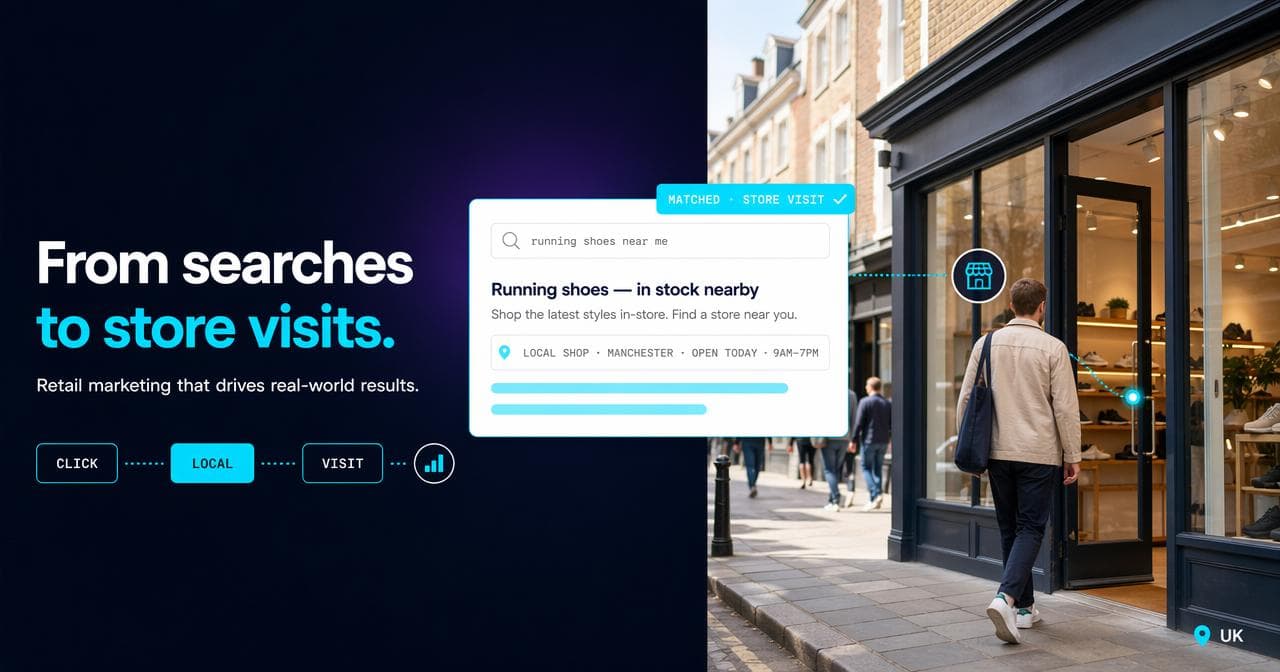
One customer, two journeys. That is the problem most UK multi-store retailers are trying to solve, and the reason most of their paid media underperforms. The shopper who clicks a Google Shopping ad on Tuesday walks into the store on Thursday, hands over cash, and disappears from the attribution model entirely. The digital campaign gets zero credit. The CMO defends a budget that cannot prove what it contributes to the sales line.
Retail marketing in 2026 is not a definition problem. It is a measurement problem. The retailers winning right now are the ones who have closed the loop between online spend and in-store outcomes. Not with a footfall counting device bolted to the door frame, but with paid media infrastructure that treats store visit data as a campaign signal.
BYLT Media runs paid media for multi-store UK retailers. The consistent finding: the moment you start optimising campaigns against real store visit data, performance improves across every format. This playbook covers what retail marketing actually means for a brand with physical stores, why most digital ad programmes fall short, the four channels that move footfall at scale, how to measure what matters, and what good agency work in this space looks like.
UK multi-store retailers in 2026 are running digital ad campaigns that cannot see the majority of their own results. More than 70% of UK retail transactions happen in physical stores, but most paid media programmes are measured on digital conversions only. Google Ads has built the infrastructure to fix this: Store Visit Conversions (Google's probabilistic model that estimates how many people exposed to an ad subsequently visited a store), Offline Conversion Tracking (importing POS transaction records directly into Google Ads), Performance Max with store goals (Google's multi-format campaign type that optimises toward in-store visits across Search, Shopping, Display, Maps, and YouTube), and Local Inventory Ads (Shopping ads that show shoppers a product is available nearby today). The retailers applying these tools to a multi-store estate with postcode-level targeting are measuring in-store ROAS. The ones who are not are optimising for a fraction of their revenue. This playbook is the practical difference between those two groups.
What retail marketing actually means in 2026
Retail marketing for a UK multi-store brand in 2026 is primarily a paid digital media problem, not a definition problem. The question is not "what is retail marketing?" -- it is "how do you connect digital ad spend to in-store revenue across a 15-location estate in the UK?"
Retail marketing is the set of activities a brand uses to attract customers to physical stores and convert them once they arrive. It is distinct from shopper marketing (which operates inside the store environment) and from ecommerce marketing (which optimises for digital transactions with no physical store in the path).
The distinction matters because the measurement frameworks differ. Shopper marketing: basket value and rate of sale. Ecommerce marketing: ROAS and CPA on digital transactions. Retail marketing: store visits, in-store conversion, and incremental in-store revenue attributable to digital ad spend.
In 2026, the dominant retail marketing discipline for multi-store UK brands is paid digital media with O2O (online to offline) attribution. Google Ads is the primary channel. The physical store still accounts for the majority of UK retail transactions, and Google Ads has the most developed infrastructure for measuring digital ad exposure against physical store visits. The BRC-Sensormatic Footfall Monitor tracks UK high street, shopping centre, and retail park visits month by month (source: https://brc.org.uk/market-intelligence/publications/monitors/footfall-monitor/).
The O2O gap: why most retailers are leaving revenue on the table
Most UK multi-store retailers are spending on Google Ads and measuring only digital conversions. The store visits those campaigns are driving -- often the majority of the total commercial outcome -- are invisible in the reporting. Closing that gap is the single highest-return action available to a retail paid media programme.
Nearby product searches carry strong purchase intent. A large proportion of those searches convert into a physical visit within 24 hours, which is why proximity signals matter for every multi-store retailer running paid media. Most UK retailers are spending money to reach these people. Very few know it is working.
Standard Google Ads reporting measures clicks, impressions, and online conversions. It does not surface store visits by default. A campaign for a furniture retailer with 15 locations will show CPCs and CTRs. It will not show how many click-throughs converted into people standing in a showroom with their card out.
The practical consequence: the paid media budget in most multi-store retailers is sized against an incomplete dataset. Campaigns that appear to underperform on digital metrics are often doing heavy lifting in physical channels that nobody has connected to the ad data.
This is the O2O gap. It is not a technology problem in 2026. Google has built the measurement infrastructure: Store Visit Conversions (Google's probabilistic model that estimates store visits from GPS signals, Wi-Fi data, Maps usage, and opted-in location history from users exposed to an ad who subsequently visited), Offline Conversion Tracking (which imports point-of-sale transaction records directly into Google Ads to attribute sales revenue to campaign exposure), and the local signals in Performance Max (Google's automated multi-format campaign type). It is an implementation problem. Most agencies do not set it up because they are not accountable for in-store outcomes.
offline conversion tracking for a full technical walkthrough of how to close this gap, including the difference between Store Visit Conversions and POS-imported Store Sales data.
The UK retail landscape: why the physical store still wins
UK ecommerce growth has flattened as a share of retail. Over 70% of UK retail spend runs through physical stores -- and for considered purchases in furniture, clothing, and electronics, the dominant pattern is still research online, buy in-store.
Ecommerce growth has not displaced the physical store in UK retail. ONS data for February 2026 puts online sales at 28.2% of all retail, which means more than 70% of UK retail spend still runs through physical stores (source: https://www.ons.gov.uk/businessindustryandtrade/retailindustry/bulletins/retailsales/latest). The ROPO effect (research online, purchase offline) is the dominant pattern for considered purchases: most people research on a screen, but the final purchase happens in-store. This holds particularly strongly in furniture, clothing, footwear, and consumer electronics.
That revenue split is the core of the business case. If more than 70% of a retailer's transactions happen in-store and digital advertising can demonstrably drive incremental store visits, treating digital campaigns as an ecommerce-only acquisition channel leaves the largest revenue pool unmeasured and underoptimised.
The four channels that drive footfall for multi-store retailers
A retail marketing programme that drives measurable store visits rests on four channels, each playing a distinct role. None of them are optional at scale for a UK multi-store estate.
| Channel | Primary role | Store visit mechanism | Attribution method |
|---|---|---|---|
| Google Search and Shopping | Capture in-market intent | Local/national campaign split with proximity signals | Store Visit Conversions |
| Performance Max with store goals | Scale across formats simultaneously | Optimises across Search, Shopping, Display, Maps, YouTube toward store visits | Store Visit Conversions + Store Sales |
| Local Inventory Ads | Surface in-store availability | Shows product is available today near the shopper | Store Visit Conversions |
| Demand Gen and Meta (secondary) | Mid-funnel awareness and retargeting | Re-engages browsers, surfaces products across visual inventory | Offline Conversion Tracking via Conversions API |
Google Search and Shopping
Search and Shopping capture in-market intent. A user searching "corner sofa Edinburgh" or "running shoes Glasgow near me" is signalling purchase intent with location context. The critical structural decision for multi-store retailers is the local/national campaign split. (https://lunio.ai/blog/strategy/google-ads-local-campaigns/) National campaigns carry brand messages and delivery offers. Local campaigns emphasise proximity and same-day availability. Without this split, budget defaults to national spend with no store visit signal.
Performance Max with store goals
Performance Max is Google's multi-format campaign type that runs across Search, Shopping, Display, Maps, and YouTube simultaneously, optimising toward a stated goal. Set up with a store goals objective, PMax routes budget toward the audiences and formats most likely to drive store visits rather than online conversions. Output quality depends entirely on input quality: asset groups, audience signals, and the product feed. See our guide to Performance Max for retail for the multi-store specifics, including how to configure store goals and avoid common feed quality pitfalls.
When the feed is accurate and real-time, PMax can serve ads showing in-store stock availability to users close to a location who are searching for that product. High intent plus confirmed availability plus proximity collapses the consideration phase.
Local Inventory Ads
Local Inventory Ads are a Shopping ad format that shows shoppers a specific product is available at a nearby store today, rather than available for online delivery. local inventory ads UK sit within PMax but can also run as a standalone Shopping format. Shoppers see the product they want is available nearby, visit today rather than wait for delivery, and the retailer moves inventory already sitting on a shelf.
"That thought of 'I can get it today' is very powerful." Google's own data shows retailers running Local Inventory Ads alongside standard Shopping ads see a 21% increase in shop visits and a 9% increase in online conversions for products shown as locally available (source: https://support.google.com/merchants/answer/14615117).
Retail advertising beyond Google
Google dominates the direct-response layer, but the full channel mix for a multi-store estate includes broader retail advertising in the UK formats: Demand Gen for mid-funnel visual inventory, YouTube for brand-building at reach, and Meta Ads for offline conversion matching via Conversions API. Each channel needs its own attribution logic. Stacking all activity through a single last-click metric misrepresents every channel in the mix.
Retail marketing strategy: building a plan that measures in-store outcomes
A retail marketing strategy that works in 2026 starts with the question: how does each channel serve a customer who researches online and transacts in-store? Budget architecture follows that question, not the other way around.
The strategic planning error most UK multi-store retailers make is organising the marketing plan around channels rather than the customer journey. A budget split of "30% Google, 30% Meta, 20% email, 20% organic" tells you nothing about how those channels serve a customer who researches on Google, sees a retargeting ad three days later, and walks in on Saturday.
A retail marketing strategy that measures in-store outcomes starts with the ROPO journey: research mode (forming intent online), decision mode (comparing options, proximity matters), visit and purchase. Budget architecture adds a geography layer. Not every store in a 30-location estate deserves equal investment. Postcode-level segmentation built from real travel patterns is the practical implementation. Standard radius targeting draws a circle on a map and ignores motorways, rivers, and transport infrastructure. It is the default. It is not the right answer when you have the data to do better.
retail marketing strategy for the full 2026 planning framework: budget architecture, channel selection, and measurement framework for a multi-store estate.
Measuring what matters: using store visit data to improve paid media
Store visit data from Google Ads is not a headcount. Used correctly, it is a bidding signal that connects digital ad spend directly to physical store outcomes and changes what the algorithm optimises for.
Store Visit Conversions use probabilistic modelling: GPS signals, Wi-Fi data near the store, Maps usage, and opted-in location history from users exposed to an ad who subsequently visited. The model produces a volume estimate, not an exact count. Directional data feeding automated bidding is more useful than no data at all.
For greater precision, POS data import (Store Sales in Google Ads) feeds actual transaction records back into the platform. The Merchant Centre connects the product feed to in-store availability; Store Sales connects till data to campaign outcomes. The campaign that drove the transaction gets credited, bidding algorithms learn from real revenue events, and reported ROAS reflects genuine business value. Without this, you are paying machine-learning rates for human-grade inputs.
offline conversion tracking and footfall data for paid media cover both sides: the first is the implementation guide for setting up the attribution layer, the second is the strategy guide for using store visit data to drive paid media decisions across a multi-store estate.
What a retail marketing agency brief should demand
A retail paid media brief structured around online conversions will produce an agency that optimises for online conversions. If most of a retailer's revenue flows through physical locations, that brief is producing the wrong output.
Most agency briefs for retail paid media are written for ecommerce: target ROAS, CPA, and online conversion volume. No store visit targets, no offline attribution requirements, no in-store measurement framework. The brief signals that digital conversions are the objective, and the agency delivers to spec.
If the majority of your revenue flows through physical locations, a brief structured around online conversions will produce an agency that optimises for online conversions. That is a different discipline from O2O retail paid media.
A brief structured for O2O asks different questions: How will you segment local and national campaigns? How will you configure Store Visit Conversions and POS import? What postcode-level targeting methodology do you use? How will in-store ROAS be reported alongside online ROAS?
The agency that cannot answer those questions clearly is running ecommerce paid media for a client with physical stores. A genuine retail marketing agency should demonstrate a named attribution methodology, a case study with in-store metrics, and a proposed measurement architecture before the engagement begins.
Book a 30-minute strategy call to discuss what an O2O-structured brief looks like for your retail estate: https://calendly.com/bmmm/30min
UK retail marketing: three case study snapshots
The same structural approach -- local/national campaign split, postcode-level targeting, Local Inventory Ads, and offline attribution -- produces measurable in-store results across retail categories. Here are three patterns from BYLT's client work.
BYLT client data, 2025: Across BYLT's retail client portfolio, offline conversion tracking and postcode-level targeting have produced +£124k in composite incremental in-store revenue from paid media. Separately, configuring Local Inventory Ads with a real-time stock feed alongside a local/national campaign split produced a 210% month-on-month increase in store visits from paid media at one furniture retailer.
National furniture retailer, 15 locations. No local/national campaign split, inefficient radius targeting, Local Inventory Ads unused. Intervention: campaign segmentation by store tier, postcode targeting from real driving-distance data, Local Inventory Ads with a real-time stock feed. Result: 210% month-on-month increase in store visits from paid media. "We were able to scale locally and put more money into the locations that bring more revenue." (source: https://www.lunio.ai/podcast/google-ads-local-campaigns)
The cross-category pattern. The same structural approach (local/national campaign split, postcode-level targeting, Local Inventory Ads, offline attribution) has been applied across furniture and pet supplies. The mechanics translate because the underlying problem is identical: a digital channel generating physical-world outcomes needs to be measured in physical-world terms.
Incremental in-store revenue from paid media. Across BYLT's retail client portfolio, Offline Conversion Tracking and postcode-level targeting have produced +£124k in composite incremental in-store revenue from paid media. The mechanics are the same across categories: measure the in-person outcome, feed it back into automated bidding, let the algorithm allocate budget to the locations and audiences that actually convert.
Automotive retail and multi-site supplement and DIY retail. BYLT's client roster includes automotive retail groups and multi-site retail operators across supplement and DIY categories. In both cases a user researches online and transacts in person. Configuring Google Ads to measure those in-person outcomes and feed the signals back into automated bidding is the same structural problem as the furniture case, applied to a different category.
retail marketing case study for the full O2O case study with methodology, measurement architecture, and CMO-level metrics.
What BYLT does differently
BYLT's point of difference is attribution infrastructure, not channel access. Google Ads, Performance Max, Local Inventory Ads, and Demand Gen are available to every agency. The difference is building the measurement layer from day one rather than adding it after the campaign has been running for six months without in-store data.
Teo Yordanov has managed more than £100m in paid media spend across retail, ecommerce, and travel (source: https://www.lunio.ai/podcast/google-ads-local-campaigns). He spoke at Brighton SEO in April 2026 on "One customer, two journeys: Stitching store visits into your Google Ads strategy" and organises SEM Stories and More, Scotland's performance marketing conference. BYLT is not a footfall counting service. What BYLT uses is Google's Store Visit Conversions and Offline Conversion Tracking: native features that attribute paid media exposure to physical store visits, without additional hardware.
If digital advertising is running at your retail estate and in-store attribution is not configured, you are optimising against a partial picture. Fixing that is a one-time setup task, not an ongoing overhead.
Book a 30-minute strategy call to discuss what this looks like for your estate: https://calendly.com/bmmm/30min
Sources.
- BRC Footfall Monitor — British Retail Consortium (accessed April 2026)
- Retail sales, Great Britain (latest bulletin) — Office for National Statistics (accessed April 2026)
- Google Ads local campaigns strategy — Lunio (accessed April 2026)
- About Local Inventory Ads — Google Merchant Center Help (accessed April 2026)
- Google Ads local campaigns (podcast) — Lunio (accessed April 2026)
- UK Digital Adspend Report — IAB UK (accessed April 2026)