Search "footfall tracking" and the first ten results sell you a sensor. Infrared counters, thermal cameras, Wi-Fi pings, stereo vision. Every vendor has a people-counting box and a dashboard showing how many warm bodies crossed a threshold last Tuesday.
None of it tells a CMO whether the paid media budget is working.
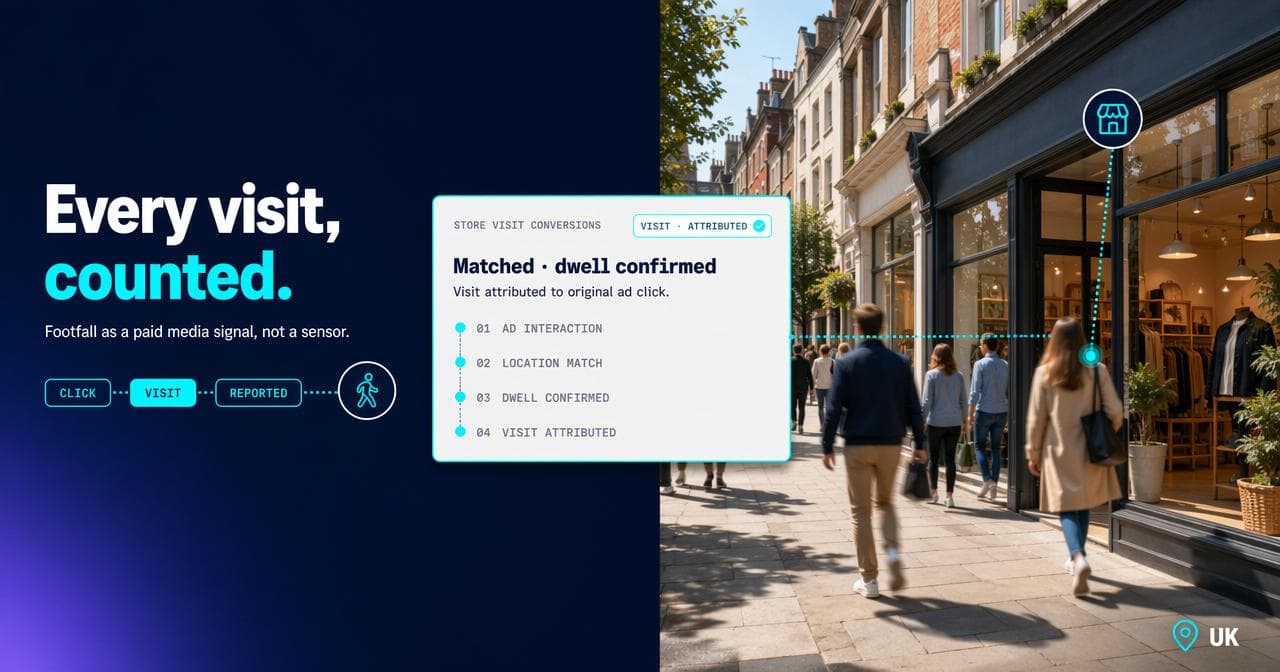
The question a UK multi-store retailer is asking is different. Not "how do I count feet," but "how do I connect Google ad spend to the store visit that follows, and use that link to bid smarter." Google Ads Store Visit Conversions and Meta Offline Conversions measure this natively. No camera, no landlord permission, no new vendor.
This article is for the marketing director with a people-counter quote on the desk, deciding whether to sign it or whether the store visit data they need is already inside their Google Ads account, waiting to be switched on.
UK retailers measuring footfall with sensors are measuring the wrong thing for paid media purposes. Hardware counters tell you how many people crossed a threshold. Google Ads Store Visit Conversions tell you how many of those people clicked one of your ads first, which store they visited, and what you paid to get them there. That distinction is the entire difference between an operations report and a media-buying input. Switch on Store Visit Conversions, connect your POS via Offline Conversion Import, replace radius targeting with drive-time postcodes, and run Performance Max and Local Inventory Ads with store-visit goals. A UK multi-store furniture retailer following this approach saw 210% month-on-month store visit lift without increasing budget. No sensor hardware involved.
Footfall tracking, re-framed: it is a measurement question, not a hardware question
For UK multi-store retailers, footfall tracking is not a property-operations decision. It is a paid media measurement question, and Google Ads already answers it natively without sensors.
Most UK SERP guides frame footfall tracking as a property-operations decision. Which sensor is most accurate, Wi-Fi or infrared, how to reconcile dwell time with conversion rate (source: https://www.mrisoftware.com/uk/blog/how-is-footfall-measured/). Those questions matter to a landlord. They do not move a paid media plan.
For a CMO at a 30 to 300 store UK retailer, footfall tracking is a media-buying input. Not "540 people walked past today," but "of the 540 who visited this week, how many clicked a Google ad in the last 30 days, and what was the cost per incremental visit." Answer that, and your bid strategy has a target.
Store visits are a measurable attribution metric showing how digital marketing translates into foot traffic. Track them properly and you optimise for total business impact, not online conversions alone.
That is the frame shift this article is built on. Everything below assumes you care about paid media outcomes, not door-counting.
Google Ads Store Visit Conversions: the native footfall measurement most UK retailers already have
Store Visit Conversions (the Google Ads product that estimates how many ad clicks resulted in a physical store visit, using opted-in device signals rather than hardware) is available to most UK multi-store retailers today, at no additional cost, inside the existing Ads interface.
Google Ads has a built-in store visit measurement product. It estimates the number of people who clicked an ad and visited a physical store within 30 days, using anonymised, aggregated data from a specific set of signals:
- GPS location from opted-in Android and iOS devices
- Wi-Fi detection near and inside the store
- Google Maps usage and direction requests
- Opted-in Google Account location history
- Verified Google Business Profiles for each store location
Full eligibility rules sit in the Google Ads Help documentation (source: https://support.google.com/google-ads/answer/6100636?hl=en-GB).
For a UK retailer with verified Business Profiles at every branch and ad traffic above Google's thresholds, this turns on inside the Ads interface. No new hardware, no property integration, no Wi-Fi captive portal. The data flows into the Conversions column, and you can run tCPA or tROAS bidding with store visits as a goal.
Eligibility is the practical gate. Google requires minimum ad clicks, minimum verified locations, and sufficient device-level location data at the store address. For most UK retailers with 30+ stores and spend above £20k a month, eligibility is automatic: a verified Google Business Profile for every trading location, active location extensions, and click volume above the platform's minimum threshold are the three signals Google checks.
The CMO takeaway: if you run Google Ads in the UK with verified Business Profiles, you likely have a footfall measurement layer available today that no sensor vendor can match for attribution precision, because it ties to ad clicks, not door events.
Offline Conversion Import: closing the loop from ad click to in-store revenue
A store visit is evidence of intent. A completed sale is the number that appears on a finance director's dashboard. Offline Conversion Import is the mechanism that closes the gap between the two inside Google Ads.
Store visits alone are not the full picture. A visit is not a sale. What matters to a finance director is revenue, which lives in the POS, not Google Ads.
This is where offline conversion tracking comes in. Offline Conversion Import (the Google Ads feature that lets you upload POS transaction data, matched to ad clicks via the GCLID, so that in-store revenue is credited to the campaign that drove it) and Store Sales Import push POS data back into Google Ads, keyed to the GCLID from the original ad click. The result is a revenue column that reflects online and in-store orders attributable to the ad campaign, not only the online slice.
Measurement is the final piece of the offline-to-online loop. Without proper integration, you would not know which products customers bought in store, only that a visit happened. With it, you assign a store-visit value, feed it into tROAS bidding, and let the platform optimise toward blended return.
For UK retailers without direct POS integration yet, Enhanced Conversions for Leads offers a privacy-durable intermediate step. Hashed email addresses from the POS are matched to the ad click, and the conversion is credited without third-party cookies.
Full upload spec and matching logic sit in Google's Offline Conversion Imports help page (source: https://support.google.com/google-ads/answer/2998031?hl=en-GB).
Why hardware footfall counters and paid media measurement answer different questions
Hardware people-counting and Google Ads Store Visit Conversions do not compete. They answer different questions for different departments, and conflating them is the mistake that sends marketing budgets into operations plumbing.
People-counting hardware has a job. It tells operations how many bodies passed a threshold, how long they stayed, where they queued. Store managers need that for staffing, layout, and landlord reporting.
What it does not do is tie a visit to the ad that caused it. A sensor sees a person walk in. It does not see the Shopping ad they clicked three days earlier on another device. Without the GCLID link, hardware data sits in a separate reporting universe from the paid media account.
Sensor-based footfall counting vs Google Ads Store Visit Conversions
| Sensor-based footfall tracking | Google Ads Store Visit Conversions | |
|---|---|---|
| What it measures | People crossing a physical threshold | Ad clicks that resulted in a store visit |
| Attribution to ads | None. No link to ad click or campaign | Full. Tied to campaign, ad group, keyword, GCLID |
| Hardware required | Yes (infrared, thermal, Wi-Fi, camera) | No. Uses opted-in device signals |
| Landlord / property involvement | Often yes. Sensor installation, data access | No. Google-side only |
| Bidding integration | None | Direct. Feeds tCPA / tROAS / Performance Max |
| Revenue attribution | None | Yes, via Offline Conversion Import from POS |
| Who it is for | Operations, property management, landlord reporting | Marketing, paid media, CMO-level P&L |
| Cost | Hardware + SaaS licence + installation | Included in Google Ads. No incremental cost |
Both can coexist. The question is which the marketing budget attaches to. Hardware belongs on the operations P&L. Paid media measurement belongs on the marketing P&L, and Store Visit Conversions plus Offline Conversion Import is the native answer.
If a vendor pitches sensors as the way to "prove your ads work," ask how the data ties back to campaign, ad group, keyword, and GCLID. If it does not, they are selling operations data badged as marketing data.
Postcode targeting: the geo-layer that feeds store visit lift
Better geo inputs produce better store visit outputs. Radius targeting is the default in Google Ads. It is also the least accurate way to define a store's real catchment area for paid media purposes.
Store visit measurement is the output. The input that shifts the number is how you choose which postcodes to spend into.
Real movement does not happen in a straight line. Rivers, motorways, and transport links all affect how far people actually travel. Standard radius targeting draws a circle around your store on a map. It ignores the real world. It is the default option in Google Ads. It is also the lazy option.
Radius targeting fails UK retail in four predictable ways.
Physical barriers. A river, an estuary, a motorway with no junction. A 10 mile radius says this person is in catchment. The 45-minute detour around the Thames says they are not.
Transport infrastructure. Same distance, different drive-times depending on A-road access and congestion. The postcode with a direct bus route to your retail park beats the one across the ring road.
Demographic variation. Two postcodes five miles apart can serve different income brackets and purchase patterns. Radius treats them identically.
Natural movement patterns. People shop where they already go. A retail park next to a Tesco Extra captures a different catchment from an identical high-street store three miles away.
Postcode targeting with drive-time analysis fixes all four. You pick postcodes that actually convert to a visit, not postcodes that happen to fall inside a circle. Combine with local inventory ads (the Google Ads product that surfaces real-time, store-specific stock in Shopping results to nearby searchers) and Local Campaigns, and you have the execution layer for the data Store Visit Conversions gives you.
Case study: 210% MoM store visits lift at a UK multi-store furniture retailer
A structured approach to Store Visit Conversions, Offline Conversion Import, and postcode targeting produced a 210% month-on-month store visit lift at a UK furniture retail group, without increasing budget.
We worked with a multi-site furniture retail group running Google Ads across Search, Shopping, and Performance Max (Google's campaign type that uses machine learning to optimise across all Google channels simultaneously, with the ability to set store visit or store sales as primary conversion goals). The brief: improve store visits from paid media without increasing blended budget.
The changes were not clever. They were disciplined.
Campaign structure. Local and national routes split. Local targeted drive-time postcodes per store, not radius rings. National handled brand and category awareness. Splitting local and national allows tailored messaging, budgeting, and optimisation.
Measurement. Store Visit Conversions on and validated. Offline Conversion Import wired in from the POS.
Execution. Local Inventory Ads fed real-time stock into Shopping ads by store. Performance Max set to store visit and store sales goals.
BYLT client data, 2025: A UK multi-site furniture retail group saw 210% month-on-month lift in attributed store visits across two quarters after implementing drive-time postcode targeting, Store Visit Conversions, Offline Conversion Import, Local Inventory Ads, and Performance Max with store goals. Budget allocation shifted organically as the bidding algorithm received better signal. Finance received a blended return number that reflected both online and in-store revenue.
Full numbers sit in our retail marketing case study write-up.
Where footfall data should actually live on a UK retailer's marketing stack
The right measurement stack for store visit attribution is already available inside Google Ads. The question is not what tool to buy but which elements are already switched on.
For a CMO building a measurement plan in 2026, the stack is clearer than the SERP makes it look.
- Google Business Profiles verified at every store. Non-negotiable. Without this, Store Visit Conversions will not report.
- Store Visit Conversions turned on. Free, native, eligible for most 30+ store UK retailers.
- Offline Conversion Import or Store Sales Import from POS. Closes the revenue loop.
- Enhanced Conversions for Leads. Privacy-durable fallback where POS integration is delayed.
- Postcode and drive-time targeting. The geo layer that makes the data actionable.
- Local Inventory Ads and Performance Max with store goals. The execution layer.
Hardware counters, if needed, live on a separate operations track. They are not a substitute for any of the six above.
This is the UK multi-store retailer paid media playbook applied to the measurement question. Get the stack right, and store visit lift is a consequence, not a project.
Work with BYLT Media
BYLT Media runs paid media for UK multi-store retailers as a retail marketing agency that measures store visits. We set up the measurement stack above, build campaign structure around it, and optimise toward blended in-store and online return. No sensor hardware. Just the paid media layer a CMO can measure and defend.
If you have a people-counter quote on the desk and want a second opinion on whether Google Ads measurement solves the same problem for less, book a call.
Book a strategy call: https://calendly.com/bmmm/30min
Sources.
- How is footfall measured? — MRI Software (accessed April 2026)
- About Store Visit Conversions — Google Ads Help (accessed April 2026)
- Import offline conversions — Google Ads Help (accessed April 2026)