Search "retail advertising" in the UK and the top ten pulls you in three directions. Retail media vendors. Out-of-home media owners. US software platforms selling generic 4Ps advice. None are written for the CMO of a UK retailer with 30 to 300 shops deciding where the media budget goes on Monday.
This article is written from inside a retail marketing agency that buys Google Ads for multi-store retailers every working day. It narrows to the five Google Ads formats UK retail CMOs actually deploy, the UK cost benchmarks that shape those decisions, and the measurement layer that turns clicks into store sales.
Retail advertising in the UK covers many channels (retail media networks, out-of-home, programmatic display, in-store advertising) but this article is about none of those. It is about Google Ads: the five formats (Search, Shopping, Performance Max, Demand Gen, and Local Inventory Ads) that UK multi-store retailers with physical shops use to capture demand, drive store visits, and measure revenue across both online and in-store. UK CPC benchmarks across these formats range from £0.20 branded search through to £4.50 on competitive generic terms. The measurement layer (Store Visit Conversions and Offline Conversion Tracking) is what separates a Google Ads programme that optimises toward total business revenue from one that only optimises toward online checkouts. That gap is where most UK multi-store retail accounts leave money on the table.
Retail advertising in 2026: the UK landscape in one paragraph
Retail advertising covers a broad umbrella of paid channels, and most of them are not what this article is about. It stretches from retail media networks inside Tesco, Sainsbury's, and Asda digital storefronts, to DOOH screens in UK shopping centres, to in-store digital retail media, to programmatic display, email, organic social, paid social, and paid search. All are real channels. BCG puts the global retail media market at around a hundred billion dollars by 2026 (source: https://www.bcg.com/publications/2022/how-media-is-shaping-retail). None are the channel this article covers. This article is about Google Ads: Search, Shopping, Performance Max, Demand Gen, and Local Inventory Ads, run for UK multi-store retailers.
Why Google Ads is the primary retail advertising channel for UK multi-store brands
Google Ads sits at the commercial intent layer of the customer journey: the point where a shopper knows roughly what they want and is deciding where to buy it. For UK multi-store retailers, no other paid channel sits closer to the purchase decision at the moment it forms.
Most customers research online and then buy in-store. That is the ROPO pattern and it is the defining shape of UK multi-store retail. When the research phase is a Google query on a phone, a query typed at 9pm on a sofa, or a near-me search on the way into town, Google Ads is the medium that sits on top of the intent. Paid search captures commercial intent at its hottest moment. Shopping ads place the product image, the price, and the shop in the same two-inch square. Performance Max stitches the inventory feed to every Google surface at once. None of the other retail-advertising channels do this.
The second reason is measurement. Google Ads has the most complete first-party conversion stack for linking a paid click to an in-store purchase. Store Visit Conversions (Google's modelled count of visits to your physical shops attributable to a paid click), Offline Conversion Tracking (actual in-store revenue imported back into Google Ads as a conversion event), and Local Inventory Ads (ads that surface real-time in-store stock to nearby shoppers) all feed the same reporting layer. Retail media networks report online sales inside the retailer's storefront. DOOH reports impressions and recall. Google Ads, configured properly, reports store visits and store revenue attributable to the campaign that caused them.
The five Google Ads formats UK multi-store retailers actually use
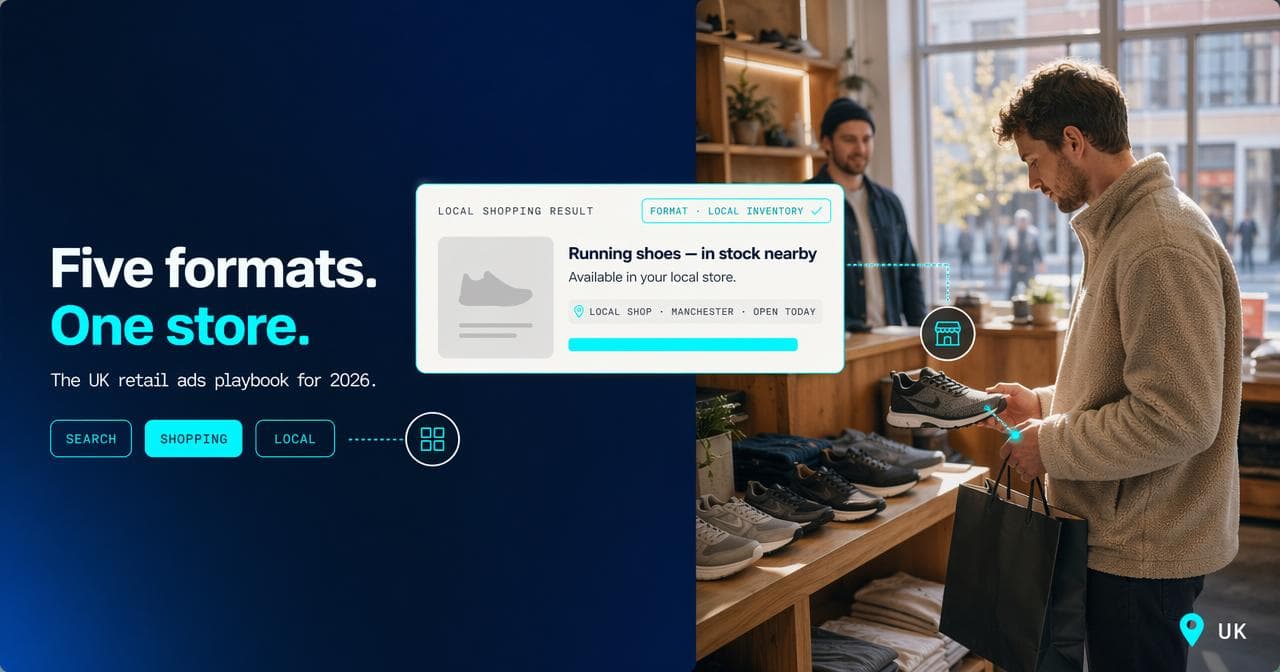
These are the five Google Ads campaign types that move the needle for a UK retailer with physical shops, and what each one does.
| Google Ads format | Retail use case | Primary metric | Store visit relevance |
|---|---|---|---|
| Search | Branded, category, and near-me queries | CPC, CVR | High. Captures intent at decision point |
| Shopping | Product browsing, price comparison | CPC, ROAS | Medium. Drives online purchase or in-store research |
| Performance Max (store goals on) | Full-funnel, all Google inventory | Store visits, blended CPA | High. Optimises toward in-store and online revenue combined |
| Demand Gen | Upper-funnel, new customer acquisition | CPM, video views | Medium. Builds awareness before near-me search happens |
| Local Inventory Ads | Near-me stock availability on mobile | Cost per store visit | Highest. Surfaces local stock to local intent |
1. Search campaigns on product plus location queries. The demand-capture engine. Branded searches, product-category searches, and near-me searches all land here. Search is where a customer who already knows roughly what they want goes to find the closest or cheapest version of it.
2. Shopping ads powered by a Merchant Centre (Google's product data platform, where retailers upload and manage their product feeds for Google Shopping and related formats) feed. The product, the price, the image, and the shop name in one unit. Shopping is where the impulse-level browsing converts. Feed hygiene sits upstream of every Shopping decision.
3. Performance Max (a single campaign type that runs across Search, Shopping, YouTube, Display, Discover, Gmail, and Maps simultaneously) with the store goals configuration. Performance Max for retail is a single campaign type that fans out across Search, Shopping, YouTube, Display, Discover, Gmail, and Maps. The store goals configuration tells Google to optimise for store visits and store sales, not just online conversions. Most agencies leave that setting off.
4. Demand Gen for the upper funnel. YouTube, Discover, Gmail, and Shorts inventory in a single visual campaign type. Demand Gen is where new-customer acquisition lives for retailers whose category needs education before the near-me search happens.
5. Local inventory ads (Local Inventory Ads: ads that show a mobile searcher which nearby shops have the item in stock, at what price, and how far away). The format that shows a shopper searching on their phone which of your local shops has the item in stock, at what price, and how far away it is. Google has reported retailers running LIAs alongside Shopping ads see a 21% increase in shop visits and a 9% increase in online conversions (source: https://support.google.com/merchants/answer/14615117).
The inventory lever is worth saying out loud. A multi-store retailer already has the product sitting on the shelf. The shipping cost is zero when the customer buys in person. That changes the maths on which formats deserve the most budget, and LIAs sit near the top of that list as a result.
UK cost benchmarks for Google Ads retail advertising
UK Google Ads costs for retail vary considerably by format and by how competitive a search term is. The ranges below reflect direct agency observation across UK retail accounts in 2026.
Google's public keyword planner data puts the headline "retail advertising" keyword itself near the £5 CPC mark in the UK, with a top-of-page bid ceiling well above £10. That is the navigational query, not the real media cost.
The real CPC ranges BYLT observes across UK retail accounts in 2026 are wider. Search on generic category terms for non-food retail typically clears £1.80 to £4.50 CPC depending on competition in the category. Branded search is far lower, usually inside £0.20 to £0.60 for non-contested brands. Shopping ads sit meaningfully below Search on identical products, in the £0.30 to £1.20 range for most non-food UK categories. Performance Max blended CPC is usually a shade below Shopping because it pulls cheaper Display and Discover inventory into the average. Local Inventory Ads deliver the lowest store-visit cost because they fire on high-intent local queries where the store is already in consideration.
These numbers are directional. Your actual costs will depend on category, geographic spread, Merchant Centre feed quality, and the number of competitors bidding in your postcodes. The point is that paid search and shopping for UK retail are not uniformly expensive. The spread inside an account is usually wider than the spread between accounts.
What makes Google Ads retail advertising different from ecom-only Google Ads
The fundamental difference is where the sale happens. Ecommerce Google Ads closes inside the browser; retail advertising is designed to move customers from a screen to a shop.
Ecommerce Google Ads is a closed loop. A click lands on a product page, a session ends in a checkout, and the revenue is attributed inside the interface. Measurement is clean because the whole journey sits inside cookies and checkout events.
Retail advertising breaks that loop on purpose. The customer uses the site to compare, check stock, pick the nearest shop, and then they travel. The ad that pulled them in never sees the sale. If your measurement stack only looks at online conversions, Google Ads will deprioritise local campaigns because they look less productive than they are, and your shop footfall will fall a fortnight later.
Three practical consequences follow.
First, smart bidding needs the right conversion target. If the target is online revenue, store visits and store sales are invisible to the algorithm and get starved. If the target is total business value with store visits valued correctly, the algorithm optimises toward the full revenue curve.
Second, the campaign split should sit along a local-versus-national axis, not a product-category axis. National campaigns carry brand and category terms. Local campaigns carry the near-me queries, postcode-targeted terms, and store-specific variants. Mixing them in the same ad group flattens the reporting signal and wastes budget.
Third, feed and location data feeding Shopping, Performance Max, and Local Inventory Ads needs to be genuinely accurate. Stale store hours, missing stock, and wrong addresses all pollute bids and hide spend.
Measuring Google Ads retail performance: store visits, not just clicks
The right measurement framework is the difference between a Google Ads programme that looks weak and one that proves its full revenue contribution, including the sales that happen in the shop.
The point of tracking store visits is not to add one more metric to the dashboard. It is to optimise campaigns for total business impact, not online conversions alone.
Offline conversion tracking for UK retailers is the layer that imports actual in-store revenue back into Google Ads as a conversion event. It is the highest-fidelity option because it reports real pounds, not modelled visits. Store visit data for paid media is the complementary layer that uses Google's location-signal modelling to report visits to your shops as a secondary conversion. Both feed smart bidding. Together they give paid search, Shopping, Performance Max, and LIA campaigns a proper view of what a click is worth.
Five reasons the store visit matters for retailers. Customer experience is higher in the shop. Average order value and conversion rate are both higher in the shop. Impulse and add-on purchases happen in the shop. Inventory turns faster when the customer collects in person. And local brand presence compounds when shoppers physically see the store.
The Google Ads mistakes UK retail brands keep making
Most UK retail accounts share the same five problems. Here is what to look for on audit.
Five patterns come up again and again on UK retail account audits.
One, running Performance Max without the store goals configuration turned on. The campaign still delivers, but it delivers for online conversions that represent a fraction of the revenue.
Two, treating the Merchant Centre feed as an IT project rather than a marketing input. Feed errors quietly kill Shopping and Performance Max quality scores.
Three, mixing local and national search campaigns in the same structure. The bidding algorithm cannot separate commercial intent profiles that belong in different campaigns.
Four, ignoring Local Inventory Ads because the feed work looks painful. The feed work is painful. The payoff is the cheapest store-visit cost in the account.
Five, measuring everything against a last-click online conversion model. In a retail account, last-click online is the metric that most undervalues paid search and Shopping.
Building a Google Ads retail test-and-learn programme
A working retail Google Ads programme starts with the measurement layer in place before the ad spend starts. Everything else is sequenced from there.
A working retail Google Ads programme is not a set of campaigns. It is a test-and-learn structure with the measurement layer in place before the ad spend starts. The operating rhythm we run looks like this.
Week one. Merchant Centre and Business Profile audit. Store feed accuracy for every location. Store Visit Conversions and Offline Conversion Tracking confirmed as live. Conversion action set cleaned and prioritised.
Weeks two and three. Campaign structure rebuilt along the local-versus-national axis. Search campaigns split. Performance Max rebuilt with store goals on. Local Inventory Ads turned on for any retailer with the feed foundation ready.
Weeks four through eight. Budget is moved between formats based on store-visit-cost and blended-CPA reporting. Low performers are paused rather than optimised into the ground.
Month three onward. Test cells for Demand Gen, new geographic tiers, and new product-feed experiments. Quarterly reviews against the same store-visit and offline-conversion benchmarks, not against online-only CPA targets.
Sources.
- How media is shaping retail — Boston Consulting Group (accessed April 2026)
- About Local Inventory Ads — Google Merchant Center Help (accessed April 2026)