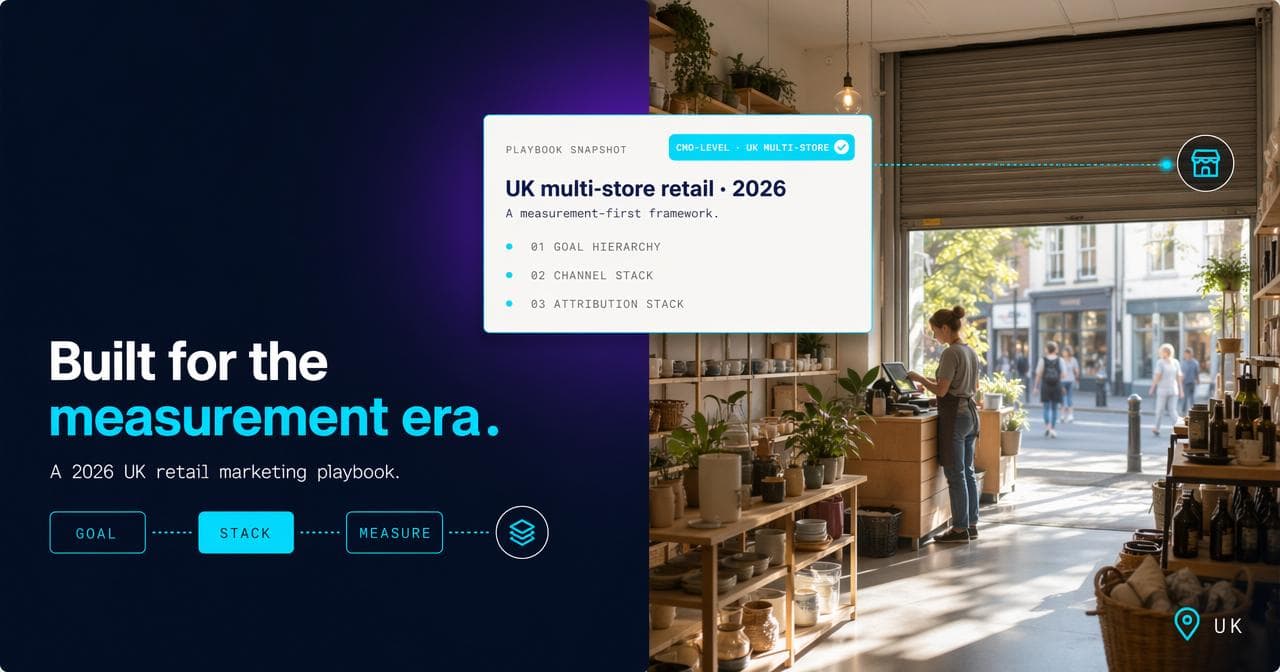
Most retail marketing strategy guides on the UK SERP read the same way. A vendor defines the term, lists ten tactics, and finishes with a product pitch. None of them show a CMO what a measurement-first strategy looks like when 70%+ of the retailer's revenue happens in a shop, not on a site.
This one does. A retail marketing strategy for a multi-store UK brand in 2026 is not a tactic stack. It is a measurement architecture that tells Google Ads to spend more in the postcode that generates a store visit, not the postcode that generates an online session. Get that right and the channel selection writes itself.
Here is the strategy, the measurement stack, and the ten-step audit to run against whatever you are doing today.
For UK multi-store retailers with 30 to 300 locations, a retail marketing strategy in 2026 is a measurement architecture first and a channel plan second. Seven in ten pounds of UK retail revenue closes in a shop, not online. Any strategy that measures only ecommerce conversions is optimising for the minority of revenue and will keep cutting budgets until the stores are empty. The practical starting point is a Google Ads structure split by local and national goals, Store Visit Conversions running for directional data, and Offline Conversion Tracking pulling POS transactions back into Smart Bidding. When the measurement layer is producing blended ROAS, the channel and budget decisions become mechanical.
What retail marketing strategy means for multi-store UK brands in 2026
A retail marketing strategy is the decision framework a brand uses to allocate budget, channels, and messaging across the full customer journey to revenue. For a multi-store UK retailer, that framework must account for both online orders and in-store transactions, because 70%+ of category revenue closes in a shop.
The strategic shape is simple to state and hard to execute. Structure the campaigns so local and national routes to purchase are budgeted separately. Measure the in-store revenue that paid media drives, not only the online conversions. Optimise the spend against the blended return, not the slice the platform can see.
If a plan does not cover those three things, it is a tactic list, not a strategy.
The strategic problem: ecom-only measurement destroys in-store marketing budgets
The single most common way a multi-store retailer ends up with an underfunded marketing operation is measuring only the conversions a platform can see.
Every multi-store retailer I work with starts the same way. Online sales are measured to three decimal places. In-store revenue from the same customer, driven by the same ad, shows up as a vague feeling that "digital is doing something." Finance sees 1.5x ROAS and asks why the team is not cutting the budget.
The ROAS number is wrong. It measures the slice of the campaign that converts online, in a category where most revenue closes in-store. Across UK retail, only 28.3% of sales happen online as of December 2025, so roughly seven in ten pounds change hands in a shop (source: https://brc.org.uk/market-intelligence/retail-in-numbers/). For considered-purchase categories like furniture, automotive, and homeware, the in-store share is higher again.
A strategy built on ecom-only measurement will keep cutting budget until the shops are empty. That is the problem this playbook solves.
Building a retail marketing strategy around the customer journey
If you are serious about retail marketing strategy, a store visit starts long before a customer walks through your door. Most people research online first and purchase in-store. That is the ROPO effect (Research Online, Purchase Offline), and it defines the shape of everything downstream.
The journey breaks into three phases a multi-store retailer can plan for.
Phase 1, Research (Discovery). The customer is Googling the category, checking Instagram, reading reviews. Search ads, Shopping ads, and Performance Max (Google's automated campaign type that combines Search, Shopping, Display, YouTube, and Maps into a single goal-based campaign) are the primary lanes. Messaging is educational, not transactional.
Phase 2, Decision (Intent). The customer is comparing options, looking at stock, reading delivery versus collection terms. Local Inventory Ads (ads that show real-time in-store stock availability to nearby shoppers on Google Search and Maps), branded Search, and retargeting carry the load. Messaging shifts to "available at your nearest store" and "click and collect today."
Phase 3, Action (Visit). The customer is deciding which shop to walk into. Radius-and-postcode-targeted local Search and Maps ads, plus verified Google Business Profiles, make the difference between a visit and a drive past. Messaging is immediate: open now, in stock, five minutes from you.
A retail marketing strategy allocates budget and creative against these three phases, not against channels in the abstract.
Channel selection: what actually drives physical store visits for UK retailers
For UK multi-store retailers, Google Ads is the primary channel stack. No other platform comes close for measurable store-visit attribution in 2026. Search, Shopping, Performance Max, and Demand Gen cover the research, decision, and action phases cleanly. Google Business Profile and Local Inventory Ads plug directly into the action phase with live stock signals.
Meta Ads is a secondary layer. Advantage+ Shopping and Advantage+ for stores can carry discovery-phase demand and visual intent, especially in categories where Instagram is a research channel. The measurement side of Meta (Offline Conversions API) is still weaker than Google's O2O stack, so Meta should not carry the primary attribution weight.
Every other channel, including programmatic display, DOOH, influencer, and retail media networks, is a tactical addition for specific campaign moments, not a pillar. If the brand cannot attribute a channel to a store visit or an online order, it does not belong in the pillar set.
Framework-first vs paid-media-led retail strategy: what changes
| Dimension | Framework-first (4Ps / 7Ps) | Paid-media-led (BYLT approach) |
|---|---|---|
| Starting point | Marketing mix taxonomy | Measurement architecture |
| Primary KPI | Brand awareness / share of voice | Blended ROAS (online + in-store) |
| Campaign structure | Channel-led (display, social, OOH) | Goal-led (local vs national) |
| Budget allocation | Split by channel type | Split by store catchment and journey phase |
| Attribution default | Last-click online | Store Visit Conversions + Offline Conversion Tracking |
| Optimisation signal | CTR, reach, frequency | In-store revenue fed to Smart Bidding |
| When it breaks | Cannot account for ROPO revenue | Requires POS access and feed hygiene |
A framework-first strategy is not wrong. It is incomplete for a retailer where most revenue closes in a physical location.
Budget architecture: the local and national split
Campaigns need to be split into local and national segments because they serve different routes to purchase and need different optimisation signals.
Local campaigns carry visit-today and click-and-collect messaging, bid against store-visit signals, and run Local Inventory Ads and Performance Max for store goals. Budget is allocated per store catchment based on drive-time postcodes, not flat radius.
National campaigns carry delivery-focused messaging and standard Shopping and Search, allocated against online-order ROAS and category demand.
A common failure mode is running a single blended campaign that optimises for neither. Spend drifts to whichever conversion the algorithm finds easier to match, which is almost always the online one. The split stops that drift.
Measurement framework: structure, measurement, optimisation
The measurement layer is where most multi-store retail strategies fail. Structure and optimisation get attention; measurement gets skipped.
The Brighton SEO framework I use is structure, measurement, and optimisation across the full customer journey. Most retail marketing fails at the middle step, not the first or the third.
Structure. Campaigns split local versus national. Product feeds clean. Google Business Profiles verified at every store. Merchant Centre (Google's product data platform that syncs inventory, pricing, and store information into Shopping and local ads) linked and healthy. No disapprovals, no feed mismatches.
Measurement. Store Visit Conversions (Google's probabilistic model that estimates when an ad click led to a physical store visit, using GPS signals, Google Maps usage, and opted-in location history) enabled for directional data (source: https://support.google.com/google-ads/answer/6100636?hl=en-GB). Offline Conversion Tracking (the process of importing in-store transaction records from a POS system back into Google Ads to close the attribution loop between ad clicks and in-store sales) layered on top via the retailer's POS export, matching in-store transactions back to ad clicks for defensible revenue. Blended ROAS calculated against combined online and in-store revenue, not online alone.
Optimisation. Smart Bidding fed with the blended conversion value. Budgets rebalanced weekly toward postcodes and stores where the in-store revenue is actually landing, not where clicks are cheapest.
The three steps are sequential. Optimising without measurement is guessing; measuring without structure produces noise.
The omnichannel trap and how to avoid it
"Omnichannel" sells seven channels when a retailer should be running three. The trap is buying presence in every lane rather than funding the lanes that demonstrably drive visits and revenue.
The test is simple. For every channel on the plan, name the phase of the journey it serves, the attribution signal that proves it is working, and the revenue route it feeds. If a channel fails any of those three questions, it is decoration.
A disciplined retail strategy runs fewer channels with deeper measurement before it runs more channels with shallower measurement.
Strategy differs for multi-store versus single-location retailers
A single-site retailer and a fifteen-site retailer do not have the same strategic problem.
Single location. Radius-and-postcode targeting around one catchment, one Google Business Profile, one feed. Local Inventory Ads and a tightly-focused Performance Max account can drive the whole paid media stack. Complexity is low.
Multi-store. Catchment overlap between stores becomes the structural issue. Postcodes split between sites. Feed hygiene across every location. Per-store budget allocation against per-store store-visit economics. This is where the measurement layer stops being optional.
A strategy copied from a single-site retailer to a multi-site one usually breaks at the catchment-overlap point. Multi-store strategy starts with the postcode map, not the ad account.
What to plan for in 2026
Three shifts matter this year and all three increase the strategic weight of measurement quality over channel spend.
AI-driven local campaigns. Performance Max for store goals and Demand Gen are pulling more of the local-versus-national budget decision into Google's algorithms. That makes the quality of the measurement signal the retailer feeds into the algorithm the single biggest strategic lever.
Performance Max for retail depth. Feed-based PMax with Local Inventory Ads is now the default replacement for legacy Local Campaigns. Strategy needs to budget for feed and inventory hygiene as a line item, not an afterthought.
Meta Advantage+ for stores. The Meta side is catching up on store-goal campaign types. Strategy for 2026 parks Meta as a secondary layer until the Google stack is producing clean signal, then layers Meta in with its own measurement.
The ten-step retail marketing strategy audit
Run this against the current strategy. Seven or more in place means the strategy is operational.
- Are local and national campaigns budgeted separately, with different optimisation signals?
- Is every Google Business Profile verified and matched to a store location in Merchant Centre?
- Are local inventory ads running on the full SKU catalogue, with stock-suppression rules for low-inventory SKUs?
- Is Performance Max for retail running with store goals, fed by a clean local feed?
- Are Store Visit Conversions enabled and reporting for every store?
- Is offline conversion tracking live via Offline Conversion Tracking import, with POS-matched revenue feeding Smart Bidding?
- Is blended ROAS the KPI in board reporting, not online-only ROAS?
- Is postcode targeting built from drive-time catchments, not flat radii?
- Are budgets rebalanced monthly toward postcodes and stores driving in-store revenue, not only cheap clicks?
- Is there a documented retail marketing case study or internal proof point with blended-ROAS numbers, not just impression data?
If fewer than seven of the ten are in place, the strategy is not operational.
For the full architecture end to end, the UK multi-store retailer paid media playbook covers the hub thinking this cluster sits under.
Sources.
- Retail in Numbers — British Retail Consortium (accessed April 2026)
- About Store Visit Conversions — Google Ads Help (accessed April 2026)