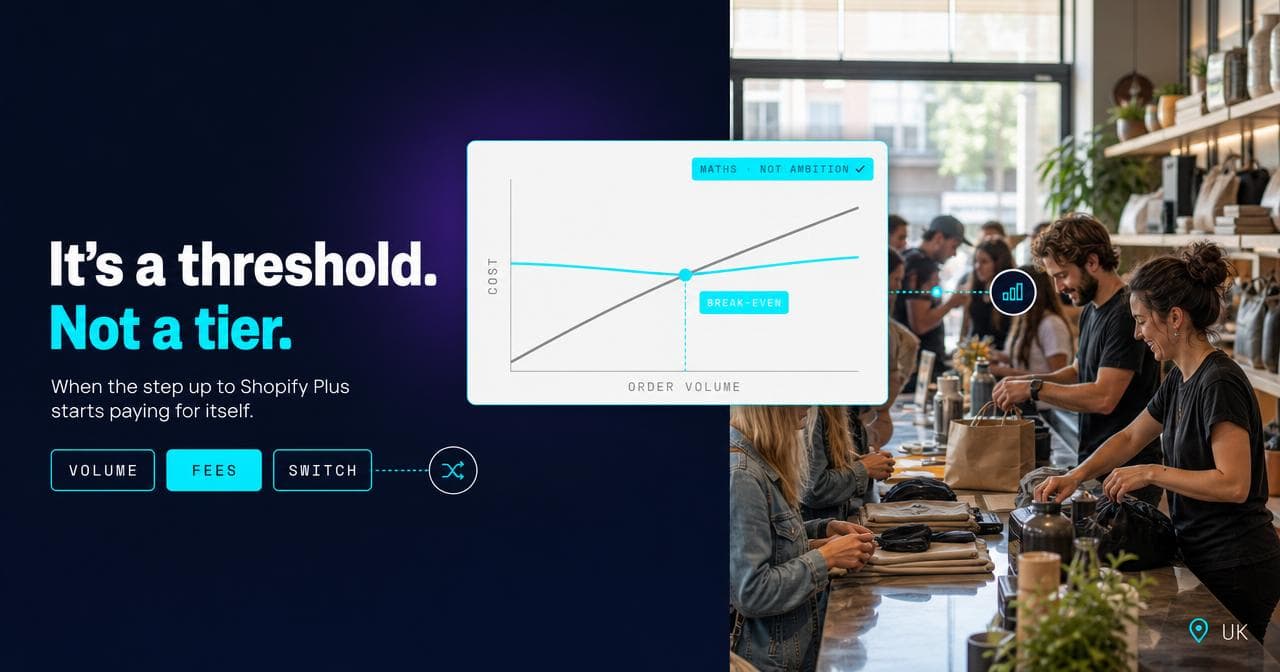
Every few weeks a store owner asks us whether it is time for Shopify Plus. It rarely starts with a feature they tried to use and could not. It starts with an account manager's email, or an agency slide that says "you've outgrown Standard," timed to a revenue number rather than anything the store has actually attempted and hit a wall on.
Shopify Plus (the top tier of Shopify's own platform, not a separate product) genuinely unlocks a short list of things: deeper checkout customisation through the Checkout Branding API and a category of checkout apps, Shopify Functions for custom discount, shipping and payment logic, a materially higher API rate limit, native multi-store and B2B tooling, and a longer, negotiated contract with dedicated support. The pricing itself is public on Shopify's site and changes shape often enough that repeating a number here would be wrong within a year. The decision that actually matters is whether one of those specific unlocks matches the thing limiting you today. For most stores that ask us about Plus, the real constraint turns out to be the theme, the app stack, or an operational process, none of which the upgrade touches. This piece covers what the tier changes for real, why checkout is the one differentiator worth taking seriously, what the API ceiling actually means, what people expect Plus to fix that it does not, the alternatives including headless, and how to tell honestly which category your store is in.
If you are the store owner being pushed toward Plus, by a rep, an agency, or your own growth curve, this guide will help you work it out before signing a contract that is not easy to walk back. It is a decision guide, not a pitch for either side.
What Shopify Plus actually is
Plus is not a separate product. It runs on the same admin and Liquid theme architecture as every plan below it, with access to the same App Store, sold as the top tier of one platform on a different contract. That distinction matters more than it sounds: almost nothing about how the storefront itself renders changes when you upgrade. What changes is a specific set of capabilities gated behind the plan, plus the commercial terms, a longer contract and a pricing structure with a revenue-linked component rather than a single flat monthly fee.
That's the first thing worth checking before anything else: is the thing you want gated behind the plan at all, or is it a setting, a theme choice, or an app you have not installed yet. In most of the audits I run, it is the second.
The one differentiator worth taking seriously: checkout
Basic checkout customisation, colours, logo placement, some field behaviour, has been available on every Shopify plan for a while now. What is genuinely locked to Plus is deeper: the Checkout Branding API and the category of apps built to customise the information, shipping and payment steps of checkout directly. Both require Plus, according to Shopify's own documentation. If what you want is cosmetic, you likely already have the tools for it on your current plan. If what you want is structural, a different flow for wholesale buyers, a payment method your current checkout cannot route to, a genuinely custom post-purchase step, that is the territory only Plus reaches.
This is also where headless builds run into a wall that has nothing to do with the front end. On a headless storefront built on any plan below Plus, the front end can be entirely custom, but checkout still redirects out to a Shopify-hosted checkout domain. A fully custom checkout domain, matching the rest of the site, is a Plus feature specifically. Worth knowing before you spend engineering budget on a headless build expecting it to also solve checkout branding, because it does not on its own.
Shopify Functions: where custom logic actually lives
The backend equivalent of the checkout question is Shopify Functions, the mechanism for writing custom discount, shipping rate and payment customisation logic that runs inside Shopify's own checkout process. The plan gate here is more specific than "Plus only": stores on any plan can install public apps from the App Store that are themselves built on Functions, so a lot of common custom-logic needs are already solved by an app you have not looked for yet. What requires Plus is building or installing a custom Functions app for logic that does not already exist as a packaged solution. If your discount or shipping rule is a standard shape, tiered pricing by customer group, free shipping thresholds by region, it is very likely already an app away. If it is genuinely bespoke to how your business prices things, that is where the Plus requirement becomes real.
API limits and throughput: the numbers that matter
Shopify's developer documentation is specific here, so I will be too: the GraphQL Admin API rate limit sits at 100 points a second on standard plans and 1,000 on Plus, a real ten-times increase, not a rounding difference. Plus stores are also exempt from a variant-creation cap that applies once a catalogue passes 50,000 variants. Standard plans are limited to 1,000 new variants a day past that point; Plus is not.
Both of those are real, and both of them are irrelevant to the large majority of stores that ask us about Plus. They matter specifically when you are running high-frequency syncs against an ERP or marketplace integration, operating a catalogue large enough to hit the variant ceiling, or building something on the API that is being throttled today, measurably, not hypothetically. If nobody on your team can point to a specific throttling error in a log, this is not your reason to upgrade.
What people expect Plus to fix, and does not
This is where most of the wasted upgrade spend happens, and it is worth naming each one directly.
Speed. Page load time on Shopify is a function of theme code and how many app scripts are loading on each template, the same mechanism on every plan. I have audited Plus stores slower than Basic ones because nobody had reviewed the app embed list. The plan tier does not touch this. What actually controls Shopify speed and SEO is theme-level, not plan-level, on any tier.
URL structure and SEO limits. The /products/ and /collections/ segments baked into every Shopify URL are locked at the platform level, identically, whether you are on Basic or Plus. Upgrading does not remove them. Only leaving Shopify's own front-end routing does that.
Design freedom. The Liquid theme architecture is the same file structure and the same constraints on every plan. A layout your current theme cannot produce is not suddenly possible because the account is now Plus.
Conversion rate, on its own. Shopify's own marketing for Plus leans on Shop Pay's conversion advantage, but Shop Pay is available to merchants on every plan, not gated to Plus. Whatever lift it offers, you already have access to it.
None of this means Plus has no value. It means the value sits specifically in checkout, Functions, API throughput and the operational layer below, not in the general capability of the storefront.
The operational layer: multi-store, B2B, support
The genuinely useful part of Plus for the right business is operational rather than technical. Native B2B tooling that runs wholesale pricing and a DTC storefront from one catalogue, multiple stores under a single contract for a group of related brands, deeper Shopify Flow automation, and a dedicated support tier with contractual response times, all of that is real, and none of it is replicable on a standard plan through an app. It is also the part of Plus that has nothing to do with the storefront's front end, which is why a business running one brand, one catalogue and one checkout flow rarely needs it regardless of revenue.
The alternatives, including headless
Going headless on Shopify, building your own front end against the Storefront API instead of a Liquid theme, does not require Plus. The API and Shopify's own Hydrogen framework are available on Basic. I built Periodico's storefront headless on Next.js against that same API, and the decision had nothing to do with plan tier: it was about the template ceiling a standard theme could not get past. What Plus adds specifically for a headless store is the custom checkout domain covered above, a real thing to want, but a narrower reason than "we need Plus to go headless," which is not accurate.
For most of the problems that get pinned on the plan, the cheaper fix is closer to home: a theme audit that finds the app scripts loading on every page regardless of relevance, or an operational fix to how orders, pricing or fulfilment actually flow, neither of which needs a new contract to solve.
The failure mode: upgrading to fix a theme or an operations problem
Of every wrong reason stores end up on Plus, this is the one that recurs most, and it is worth naming precisely because it is expensive to reverse. A store's product pages load slowly, or checkout abandonment feels high, or launching a second regional storefront feels harder than it should. The instinct is to read that as a platform ceiling and reach for the upgrade. In the accounts I have audited, the slow product page is nearly always an app-embed problem. Checkout abandonment is usually a trust or shipping-cost transparency issue, visible before checkout even starts. A second storefront that is hard to launch is usually a catalogue and fulfilment structuring problem, not a plan limitation. Plus does not touch any of the three. The upgrade gets signed, the contract runs for its full term, and the actual problem is still there six months later because it was never a Plus problem to begin with.
How to tell if your constraint is really the plan
Before signing, name the specific wall, not the general growth feeling. Do you have a checkout requirement that a Checkout Branding API customisation or a Plus-only app genuinely solves and a standard-plan app does not? Is an integration actually being throttled today, with an error you can point to, not a worry about future scale? And does the business genuinely need multiple stores, or a combined B2B and DTC catalogue under one contract, rather than just one growing store? If none of those are true yet, the money is very likely better spent on a theme audit, an app-stack review, or fixing the operational thing that is actually slowing the business down, all of which cost less and take less time to prove out than a Plus contract does.
If you are trying to work out which category your store is actually in, that diagnostic, whether the constraint is really the platform, the theme or the operations, is the starting point of most engagements our website team runs, before recommending anything as large as a plan change.
Sources.
- Shopify Plus overview — Shopify (accessed August 2026)
- Admin API rate limits — Shopify (accessed August 2026)
- Customize checkout configurations — Shopify (accessed August 2026)
- Shopify Functions plan eligibility — Shopify (accessed August 2026)