Ask an ecommerce founder for their SEO strategy and what I usually find is a spreadsheet: a long list of fixes, a priority column where almost everything is marked high, and no row that says what the team is going to stop doing. That's a task list wearing a strategy's name. A real strategy has an opinion about which categories are worth fighting for this year and which ones you concede, and it sequences the rest against how long each piece actually takes to pay back.
An ecommerce SEO strategy is a set of decisions, not a checklist: which categories you're going to compete for, which you're deliberately leaving alone, what gets built first because it pays back fastest, and how the plan hands off to paid where organic can't reach yet. This piece covers finding the near-misses worth chasing before anything new gets built, choosing categories to fight for versus concede, why category pages usually carry more organic weight than product pages, where a content layer genuinely helps, internal linking as a deliberate lever rather than housekeeping, a realistic order of operations across two quarters, how this interacts with paid spend, and when a formal strategy is the wrong tool right now.
The founder or head of ecommerce who has to decide what happens over the next two quarters is the intended reader here, not the person executing each individual fix. It's a decision framework, not an audit checklist: deciding what to do, rather than diagnosing what's broken, which is a different piece of work.
What "strategy" needs to decide that a task list doesn't
A task list tells you what to fix. What most SEO documents skip is the harder half: deciding what you are deliberately not doing this year because the payback isn't there yet, and what order the rest happens in. I've found saying no to a category, a content type or a whole market segment is a harder call than adding another row to a spreadsheet, which is exactly why most documents avoid it.
In the accounts I run, the strategy conversation happens before any execution starts, and it answers where the domain is already close enough that it's worth pushing, which categories are worth contesting against the search results as they currently stand, which pages actually carry the site's organic weight, and what gets built first versus what waits until there's evidence to justify it.
Start from where you're already close, not from zero
Before deciding what to build, look at what's already nearly working. Pull every category and product page ranking somewhere in roughly the eight-to-twenty position range in Search Console or a rank tracker. That band is the cheapest inventory a strategy has: pages Google has already decided deserve to compete for the term, sitting just short of the traffic page one delivers.
A near-miss category page usually needs some combination of a stronger internal link path from higher-authority pages, a content section that actually answers the query rather than just sitting above a product grid, or a handful of on-page fixes that were never done properly. None of that is glamorous, but in my experience it's reliably the fastest payback in the plan, usually before anything newly built has had time to be crawled, judged and re-ranked.
Treating this list as an afterthought instead of the starting point is the error that crops up again and again. It happens most when a domain chases several new head-term categories while a handful of near-miss pages, already sitting just outside page one, go untouched. It costs more and takes longer, for no better reason than the near-miss list being less exciting to present.
Choosing which categories to fight for, and which to concede
This is the decision most strategy documents avoid making explicitly, and it's the one that determines whether the rest of the plan is realistic. Look at who currently holds page one for your priority categories. If it's national retailers with several times the referring domains you have and years of content history behind them, that category isn't winnable inside the timeframe a strategy usually covers, whatever the search volume says.
On ecommerce accounts that come to us after a previous SEO relationship stalled, the same pattern turns up repeatedly: chasing head terms the domain genuinely can't win yet, while category pages that are one or two links and a content pass away from ranking sit untouched. The head term looks like the obvious target because it has the biggest number attached to it in keyword research. It's also the one a competitor has spent years, and a much bigger link profile, earning.
Conceding a category on purpose isn't giving up on it forever. It means the domain's current authority is better spent on categories one tier down, the ones with real but less crowded demand, where a realistic amount of work actually moves the position. Revisit the conceded list periodically as authority changes; a category unwinnable last year is sometimes winnable this year, and the reverse holds too if a competitor invests heavily.
Category pages, not products, are the asset carrying the weight
Most ecommerce SEO effort still gets spent on individual product pages: titles, descriptions, a bit of schema, and then it stops. Category pages are usually the more valuable asset, and the more neglected one: they can rank for the broad, high-volume commercial terms a single product page never will, and they survive when an individual product sells out or gets discontinued.
A category page needs three things a lot of ecommerce sites never give it: a genuine block of text that answers what someone searching the term actually wants to know, not filler above a product grid; a stable URL that survives a re-merchandise of the products underneath it; and internal links pointing at it from elsewhere on the site, not just the main navigation. Product pages matter too, particularly for long-tail and branded search, but they belong in the second layer of the strategy, not the first.
Platform matters here more than almost anywhere else in this plan, because how much control you have over a category page's URL, canonical behaviour (which version of a page Google is told is the definitive one) and filter handling varies sharply between Shopify, Magento and WordPress with WooCommerce. Worth reading on its own if this is where the plan is stalling: what each platform lets you change for SEO.
Where the content layer genuinely helps, and where it's dead weight
Content gets added to ecommerce strategies as a reflex, a blog, buying guides, a resource hub, without much thought about what it's actually for. It has two legitimate jobs here: giving category pages the substantive text they need to rank, and capturing informational demand around the purchase decision that a transactional category page can't answer without becoming cluttered.
What it isn't for is filling a content calendar. A blog post that doesn't link back into the category or product pages it's meant to support, or that targets a keyword with no realistic commercial adjacency, is effort spent on a page that will sit at position thirty and do nothing for the pages that actually convert. Before commissioning a content piece, the question worth asking is which category or product page gets a link out of it.
On Periodico, the headless Shopify storefront I built for a fashion client, the content decisions that mattered most were about the collection pages themselves rather than a separate blog layer: what the page said above the product grid, and how it linked sideways into adjacent collections. That's usually where the return sits before a dedicated content programme is worth the investment. More on that build.
Internal linking is the cheapest lever most plans skip
Internal linking gets treated as housekeeping, something a developer fixes once and forgets, rather than one of the few genuinely free levers in an SEO strategy. It costs no ad spend, needs no new content in most cases, and it's a large part of the mechanism that tells Google which pages on the site actually matter.
The category pages identified as near-misses or priority targets should be the ones receiving deliberate links from your highest-authority pages: the homepage, top-level categories, and any content that already ranks well. On Magento accounts in particular, that often means going through the module and template stack directly, because the default navigation and breadcrumb structure rarely sends links to the pages that need them most; it's a recurring piece of the 18 Carati work.
A useful discipline: every time a new page goes live, decide which three existing pages should link to it before it's published, not after. That single habit does more for a mid-sized catalogue's organic performance over a year than most content commissioned specifically to build links.
Sequencing: what pays back first, and what waits
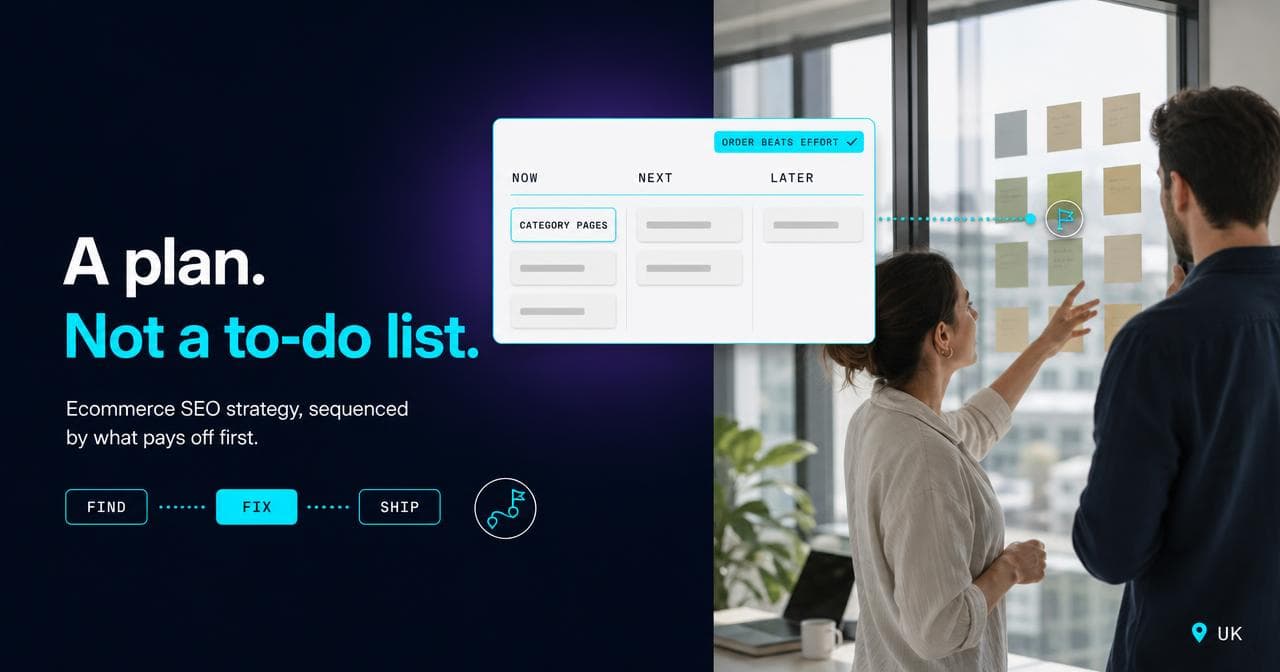
A realistic two-quarter plan usually runs in three stages, and the order matters more than the individual tasks. First, the near-miss pushes and internal linking fixes above, because they touch pages Google already trusts and results show up fastest, often within a few weeks of a crawl and re-index. Second, the category-page rebuild for the categories chosen to fight for: content, structure, canonical handling and internal links working together on a page with little or no ranking history.
Third, and only once the first two stages have evidence behind them, new category or content builds aimed at genuinely new demand. This stage is the slowest to pay back, because a page with no history has to be crawled, indexed and then earn trust over months rather than weeks, and it's the stage most strategy documents want to start with, because it's the most exciting one to plan.
Two quarters is enough time to run all three stages and see real movement on the first two. It's rarely enough to see a brand-new category fully mature, which is the honest answer whenever a founder asks when a new page will rank on page one: usually not inside this window, and any strategy that promises otherwise is setting an expectation it can't keep.
Where paid media should pick up what SEO can't reach yet
An SEO strategy that ignores what's happening in paid is incomplete, because the two channels work the same demand and should hand off deliberately rather than compete for the same click. The categories just conceded in the SEO plan, the ones the domain genuinely can't win organically inside this window, are usually the ones worth the heaviest paid Shopping or search investment, because paid doesn't care how many referring domains a competitor has.
The reverse matters too: once a category page starts ranking well organically, that's usually the signal to taper branded and category-level paid spend on that term. I check this deliberately on accounts running both channels, because without someone actually looking, paid budgets tend to keep bidding on terms long after organic has taken over the position.
None of this works if SEO and paid are planned by two people who never compare notes. The category triage above, fight for versus concede, is exactly the document that should sit in front of whoever owns the paid budget too.
When a formal strategy is the wrong tool right now
A strategy document assumes an existing site with an existing category structure to triage. If the store is pre-launch, or just replatformed, or the category structure itself is still being decided, writing a formal SEO strategy is premature; the decision that actually needs making first is the information architecture, not the SEO strategy sitting on top of it.
It's also the wrong tool if organic is already the majority of revenue, growing steadily, and nothing about the market has changed. In that state, a strategy re-think risks manufacturing work to justify itself. What's actually needed is a maintenance cadence: a near-miss check every quarter, a technical health check twice a year, and the discipline to leave a working system alone. Strategy work earns its cost when something has genuinely changed: a replatform, a new competitor taking share, a category expansion, or growth that's stalled without an obvious cause. Absent one of those, the honest advice is to keep doing what's working.
If you're working through this triage on your own catalogue, this is close to how I run the first stage of any new SEO engagement for ecommerce and retail clients: find what's already close before building anything new, then let the category triage decide the rest.
Sources.
- Make your links crawlable — Google Search Central (accessed August 2026)